

Awais Hamza: Neural Tube Defects – Embryology Meets Prenatal Ultrasound
Awais Hamza, Virtual Medical Assistant at SNS Rheumatology Associates, shared a post on LinkedIn:
“Neural Tube Defects (NTDs): Embryology Meets Prenatal Ultrasound
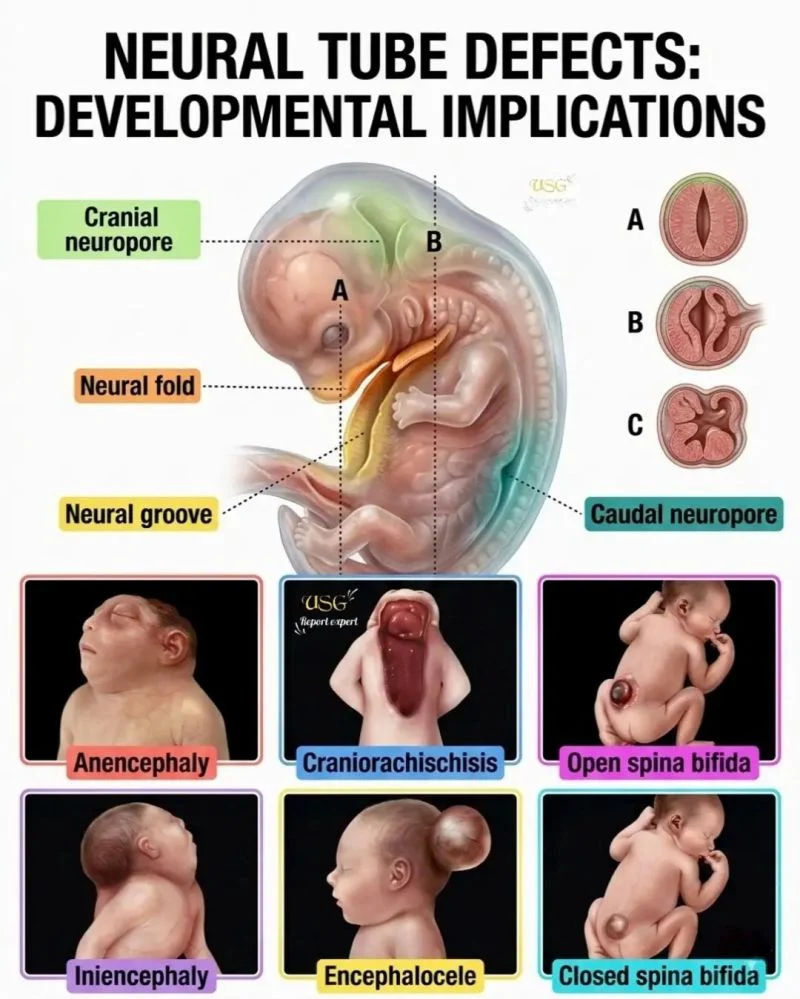
Neural tube defects occur when the neural tube fails to close properly during the first 4 weeks of embryonic development. The location and timing of closure failure determine the type and severity of the anomaly.
Early prenatal ultrasound plays a critical role in detecting these conditions, counseling families, and guiding pregnancy management.
Key Neural Tube Defects & Ultrasound Findings
Anencephaly • Failure of cranial neuropore closure • Absence of calvarium and cerebral hemispheres • Classic ultrasound appearance: ‘Frog-eye sign’ • Detectable as early as the first trimester • Lethal condition
Craniorachischisis • Failure of both cranial and spinal neural tube closure • Combination of anencephaly with extensive open spinal defect • Ultrasound: absent cranial vault with exposed neural tissue extending along the spine • Rare but severe neural tube defect
Open Spina Bifida (Myelomeningocele) • Failure of caudal neuropore closure • Ultrasound findings:
Spinal defect with protruding sac
Lemon sign (frontal bone scalloping)
Banana sign (curved cerebellum)
Ventriculomegaly may be present • Often associated with Chiari II malformation
Closed Spina Bifida • Skin covers the defect • More subtle prenatal sonographic findings • May show soft tissue mass, lipoma, or vertebral abnormalities • Neurological impairment varies
Encephalocele • Herniation of intracranial contents through a skull defect • Usually occipital in location • Ultrasound: extracranial cystic or solid mass connected to the cranial vault • Evaluate contents carefully (meninges vs brain tissue)
Iniencephaly • Severe cervical spine malformation with extreme retroflexion of the fetal head • Short spine and defective occipital bone • Ultrasound: fixed hyperextension of the head and neck • Often associated with other congenital anomalies
Sonographer’s Pearl Whenever an open neural tube defect is suspected, carefully evaluate:
- Posterior fossa
- Ventricular system
- Spine in sagittal, transverse, and coronal planes
- Associated intracranial markers
- Amniotic fluid volume and associated anomalies
Early diagnosis allows multidisciplinary counseling and optimized prenatal care.”
Stay updated on all scientific advances in the field of fertility with Fertility News.
-
Oct 22, 2026, 17:36Filipa Rafael: A Woman Should Not Have to Be Trying for a Baby for Her Ovarian Insufficiency to Matter
-
Oct 22, 2026, 17:30Michele Boiani: New Insight on Zona Pellucida Proteins
-
Oct 22, 2026, 17:01Sean Lauber: New Review Assesses PGT-A Effectiveness and Safety
-
Oct 22, 2026, 16:56Eric Lameignere: Optimizing Sperm Handling Conditions in the IVF Laboratory
-
Oct 22, 2026, 16:49Rajeev Agarwal: Most Failed IVF Transfers Are About the Embryo, Not the Uterus
-
Oct 22, 2026, 16:44Devyanshi Dixit: Calling for Delegates for GFWH 2026
-
Oct 22, 2026, 16:35Kate Ryder: Headed to ASRM 2026 and Looking Forward to Spending Time with Clinic Partners
-
Oct 22, 2026, 16:27Can PCOS/PMOS Increase the Risk of Premature Death? – PCOS Millennials
-
Oct 22, 2026, 16:18Margaret Cali: Before IVF Begins, a Lot of Preparation Happens…