
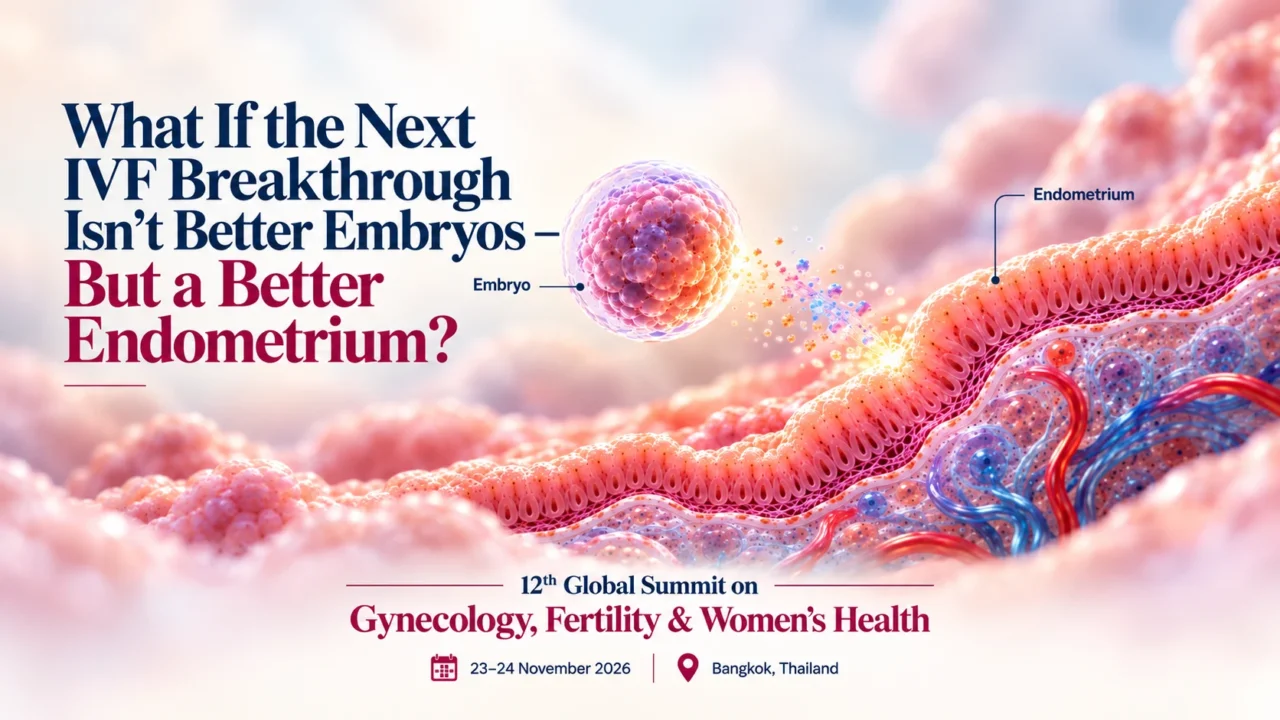
Devyanshi Dixit: What If the Next IVF Breakthrough Isn’t Better Embryos?
Devyanshi Dixit, Program Manager at CLS Event and Publication and Conference Manager at the 12th Global Summit on Gynecology, Fertility and Women’s Health, shared on LinkedIn:
“A high-quality embryo can still fail to implant.
But does that mean the embryo was the problem?
IVF has made remarkable progress in embryo culture, genetic assessment and selection.
Yet implantation remains a biological interaction, not a laboratory result alone.
The endometrium is more than a landing surface.
It is dynamic tissue that:
- responds to hormonal signals,
- undergoes cellular differentiation,
- coordinates molecular processes that help determine whether implantation can proceed.
This raises a more interesting question:
Are we measuring the uterine environment accurately enough to understand why implantation succeeds – or fails?
Endometrial thickness and molecular receptivity tests can provide information, but neither tells the whole story. Receptivity is multifactorial, involving the timing of endometrial development, tissue function and communication between the embryo and maternal environment.
Here is where scientific ambition must meet clinical evidence.
A 2023 systematic review and meta-analysis of 12 studies involving 14,224 patients found no significant improvement in live-birth outcomes with endometrial receptivity analysis compared with standard embryo-transfer protocols.
The UK’s 2026 NICE guideline goes further, recommending against routine endometrial receptivity testing as an IVF add-on.
That does not make endometrial research less important.
It makes the research question more precise.
The opportunity is not simply to develop more tests.
It is to identify which biological mechanisms matter, which patients may benefit from targeted investigation, and which interventions demonstrably improve live-birth outcomes.
The next advance may come from understanding the embryo-endometrium relationship more deeply – not from assuming that either side is solely responsible.
At GFWH 2026, these questions belong in the conversation between reproductive clinicians, embryologists, and researchers.
- November 23-24, 2026
- Bangkok, Thailand
- Hybrid participation
- Professionals from 50+ countries
For fertility specialists and researchers: what should the next generation of implantation research prioritize – better biomarkers of endometrial function, a deeper understanding of embryo-maternal signaling, or evidence-based interventions for specific patient groups?
I’d welcome your perspective.”
Other articles featuring Devyanshi Dixit on Fertility News.
-
Nov 9, 2026, 16:34Kathiuska Kriedt: The “One Follicle Girl”
-
Nov 9, 2026, 16:23Resa Nabor: Why It’s Important to Pay Attention to Your Symptoms
-
Nov 9, 2026, 16:12Göksu Dirgin: Mosaic Embryos – IVF’s Unsolved Riddle
-
Nov 9, 2026, 15:59Robert Gilchrist: Honoured to Present at the 9th International Conference on Human Fertility Protection and Preservation
-
Nov 9, 2026, 15:54Camille Hammond: I Went Through Infertility Treatment While Training to Be a Doctor
-
Nov 9, 2026, 15:49Sean Lauber: Do Zymot or Other Microfluidic Devices Improve IVF Success?
-
Nov 9, 2026, 15:44Clare Mansfield: Transforming Fertility Care So That People Feel Seen, Heard and Supported
-
Nov 9, 2026, 15:37Thanos Papathanasiou: The Effect of Male Smoking on IVF Success
-
Nov 8, 2026, 15:46Finding the Right Doctor When You Have PCOS – PCOS Millennials