

Beata Blazkova: Does Every IVF Laboratory Need AI for Embryo Selection?
Beata Blazkova, ESHRE-Certified Senior Clinical Embryologist at Prague Fertility Centre, shared a post on LinkedIn:
“AI is available. Everyone is talking about it. But does every IVF laboratory actually need it?
What if embryo selection isn’t your biggest bottleneck?
AI adoption should start with the problem a laboratory needs to solve – not with the technology available on the market.
In my latest article, I explore why the right AI strategy may differ between laboratories, even within the same clinic network.
Does Every IVF Laboratory Need AI for Embryo Selection?
Not if embryo selection isn’t your biggest bottleneck
AI is becoming an increasingly important part of reproductive medicine.
From embryo selection to sperm detection, new tools promise to improve efficiency, consistency and decision-making.
But there is a question worth asking before the next purchasing decision:
What if the AI being offered is not the solution that a particular laboratory needs?
A high-volume laboratory may struggle with the time required for embryo assessment.
Another may spend hours searching for rare spermatozoa.
Athird may want to reduce variation in assessments between embryologists.
These are different problems. They deserve different evaluations.
When AI for embryo selection makes sense?
Consider a laboratory handling a high volume of treatment cycles, where embryo assessment takes up a substantial part of the embryologists’ working day.
Its embryologists may already be highly experienced. The challenge is the time required to assess embryos, particularly when staff capacity is limited.
In a multicentre, randomised, double-blind trial involving 1,066 patients, Illingworth et al. compared deep-learning-based embryo selection with conventional morphological assessment. The AI approach reduced assessment time substantially, but the study did not establish non-inferiority for clinical pregnancy rates. [1]
This is an important distinction. The study demonstrated an operational advantage, but it did not establish equivalent clinical pregnancy outcomes.
For a laboratory facing a genuine capacity constraint, AI-assisted embryo selection may still be worth evaluating. The decision should take both the time-saving potential and the clinical evidence into account.
Now consider a laboratory with a shortage of senior embryologists. Its objective might be to support less experienced staff, improve consistency and identify cases requiring senior review.
Here, assessment time alone would not be enough to judge success. The laboratory would also need to examine reliability, performance across different levels of experience and the effect of AI recommendations on clinical decisions.
And what if a laboratory has sufficient experienced staff, manageable workloads and an established selection process? AI might still offer value, but the case for prioritising embryo selection would need to be demonstrated.
When the real bottleneck is finding sperm.
Consider a laboratory performing a high volume of cycles involving surgically retrieved sperm, particularly in patients with non-obstructive azoospermia.
Searching testicular tissue for rare spermatozoa can be prolonged and labour-intensive. It requires sustained concentration and occupies embryologists who may be needed for other time-sensitive procedures.
An AI-assisted sperm detection tool addresses a different challenge from embryo selection: identifying candidate spermatozoa in complex microscopic images.
A 2024 proof-of-concept study evaluated an AI-assisted sperm detection tool using azoospermic samples. Its second phase included two small cohorts of patients with non-obstructive azoospermia, with four patients in each cohort. The study explored whether AI could assist embryologists and improve the efficiency of sperm searches. These early findings are promising, but the study is too small to establish broad clinical effectiveness across laboratories. [2]
For a clinic where sperm searches consume substantial staff time, evaluating this type of tool could be more relevant than investing in AI-based embryo ranking. The priority depends on the workload, the clinical context and the problem the laboratory is trying to solve.
The problem with buying AI first and finding a use for it later.
There is another scenario worth considering.
A vendor presents an AI product, demonstrates its capabilities and explains why the laboratory should adopt it. The technology may be impressive. Its potential benefits may be genuine.
But what happens if the laboratory has no clearly defined need for it?
The team may start looking for a place to fit the product into its existing workflow. Staff have to learn another system, processes may need to change, and additional verification steps may increase the workload. The promised benefits may never materialise. The tool may end up being used inconsistently – or barely used at all.
These are recognised challenges in healthcare AI implementation. A systematic review identified barriers including workflow misalignment, inadequate training, increased workload, resistance from healthcare professionals and limitations in infrastructure and resources. [3]
A product demonstration cannot establish whether a particular laboratory needs that product. That requires an assessment of its current workflow, its constraints and the outcomes it wants to improve.
Before purchasing, a laboratory should be able to answer three questions:
- What specific problem are we trying to solve?
- What measurable improvement would justify the investment?
- What evidence shows that this tool can deliver that improvement in our setting?
If those questions have no clear answers, the laboratory may not be ready to buy.
AI implementation needs a sequence, not just a shopping list.
A laboratory might invest in AI for embryo selection, only to discover that its most pressing bottleneck lies elsewhere.
Adding another AI system to address that problem means another implementation process, another learning curve and potentially another layer of complexity in the workflow. Introducing several tools before the first is properly integrated and routinely used can stretch staff capacity and undermine adoption.
‘Implementing one tool well may deliver more value than introducing three at once.’
Identify the priority, implement the chosen tool, establish that it works in routine practice, and then assess what should come next.
This does not mean that every project must wait until all other implementation work is complete. It means that the laboratory’s capacity for change, staff workload and the practical success of each implementation should inform the order of adoption.
Research on healthcare AI implementation identifies workflow integration, training and organisational readiness as important considerations. [3]
One AI system across an entire clinic network? It depends.
There is a legitimate reason why a clinic network might choose to implement the same AI system across all its laboratories: standardisation.
A network may want to reduce variation in embryo assessment between sites, establish common evaluation criteria and make decisions more consistent, regardless of which clinic a patient attends. These are valid objectives, even when saving time is not the primary motivation. But before trying to standardise outcomes, a network needs to understand why they differ in the first place.
One network, different bottlenecks, different solutions.
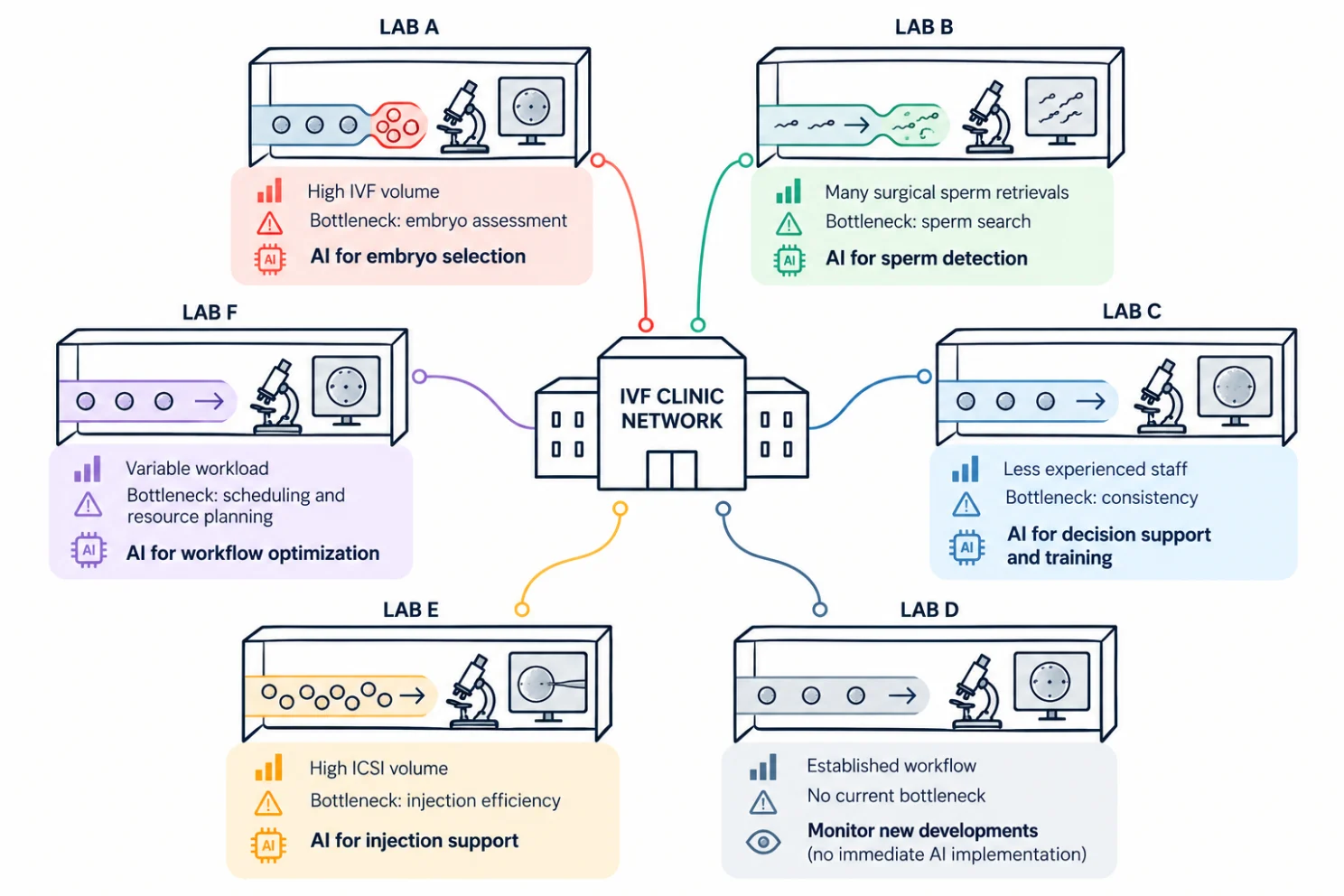
The infographic illustrates how individual laboratories within the same network can have different operational constraints and therefore benefit from different AI applications
First, identify the source of the problem
Imagine that one clinic consistently achieves poorer results than the others. Introducing AI for embryo selection might seem like a logical way to address the difference.
But where does the problem actually originate?
Is the clinic experiencing low fertilisation rates, suboptimal embryo development or a lower number of embryos available for selection? Or does the variation arise during embryo assessment and prioritisation? The distinction matters.
The Vienna Consensus established performance indicators for different stages of IVF laboratory practice, including fertilisation and embryo development. The Maribor Consensus similarly defined indicators for monitoring the clinical stages of ART. These frameworks support a systematic approach to identifying where performance differences occur before deciding what needs to change.[5] · [6]
AI-assisted embryo selection may help standardise embryo assessment, but it cannot directly correct problems originating earlier in the process. If a laboratory produces fewer embryos suitable for transfer because of problems with fertilisation or embryo development, standardising the selection stage will not resolve the underlying cause.
Before standardising the solution, identify the source of the problem.
Otherwise, a network risks investing in technology that makes one part of the process more consistent without improving the outcome it set out to change.
The people using the system matter, too.
If a tool is introduced without understanding how individual laboratories work, it can add steps, complicate established processes and increase the time required for routine tasks. Staff may not see the benefit, particularly if the system addresses a problem they do not experience. They may then use it inconsistently, work around it or stop using it altogether. The network has paid for a common solution, but the intended benefit never reaches routine practice.
Research on AI implementation in hospitals identifies integration into existing processes as a key factor in successful adoption. The same review distinguishes seamless integration, which supports implementation, from disruptive integration, which can become a barrier. [4]
A network-wide AI strategy can therefore make sense, but the implementation should not end with a group purchase. Each laboratory needs to assess how the system fits its workflow, what training is required and whether the intended benefits are actually being achieved.
Centralised procurement and local implementation assessment are compatible.
In fact, combining them may be the more practical approach.
What should responsible AI adoption look like?
The process should start with the laboratory’s objectives.
- Identify the bottleneck. Establish how the current workflow performs and where time, expertise or consistency are most constrained.
- Define success before evaluating products. Depending on the application, this might mean reduced assessment time, improved sperm detection sensitivity, fewer missed findings, greater consistency or better clinical outcomes.
- Examine the evidence. Were the results obtained retrospectively or prospectively? Do the study population, equipment, workflow and intended use resemble those of your laboratory? What limitations remain?
- Evaluate the technology in practice. Involve the embryologists who will use it, assess integration and training requirements, and monitor whether the expected benefits materialise after implementation.
Technical performance alone does not establish that a tool will be useful in routine clinical practice. Research on healthcare AI implementation supports a structured approach that considers organisational needs, human factors, workflow integration and ongoing monitoring. [3] · [4]
Choosing AI is a laboratory strategy decision
AI will increasingly be part of IVF laboratory practice. The important decisions now concern where it can make a meaningful contribution, what evidence supports its use and how it should be introduced.
For some laboratories, embryo selection will be the priority. For others, sperm detection or a different application may offer greater value. A network may reasonably choose one system for all its sites to support consistency, provided that the system meets the network’s objectives and can be implemented effectively in each laboratory.
And some laboratories may conclude that a particular AI tool is not a priority for them at present. That conclusion deserves the same evidence-based consideration as the decision to invest.
When the next AI solution is presented to your laboratory, start with a practical question:
Which bottleneck are we trying to solve – and how will we know if the solution works?
References
1. Illingworth PJ, Venetis C, Gardner DK, et al. (2024). Deep learning versus manual morphology-based embryo selection in IVF: a randomized, double-blind noninferiority trial. Nature Medicine, 30, 3114–3120.
2. Evaluation of an artificial intelligence-facilitated sperm detection tool in azoospermic samples for use in ICSI. Reproductive BioMedicine Online, 49(1), 103910 (2024).
3. Artificial intelligence adoption challenges from healthcare providers’ perspectives: A comprehensive review and future directions. Safety Science (2025).
4. Implementing AI in Hospitals to Achieve a Learning Health System: Systematic Review of Current Enablers and Barriers. Journal of Medical Internet Research (2024).
5. ESHRE Special Interest Group of Embryology and Alpha Scientists in Reproductive Medicine (2017). The Vienna consensus: report of an expert meeting on the development of ART laboratory performance indicators. Human Reproduction Open, 2017(2), hox011.
6. ESHRE Clinic PI Working Group (2021). Maribor consensus: report of an expert meeting on the development of performance indicators for clinical practice in ART. Human Reproduction Open, 2021(3), hoab022.”
Proceed to the video attached to the post.
Other articles featuring Beata Blazkova on Fertility News.
-
Oct 22, 2026, 16:49Rajeev Agarwal: Most Failed IVF Transfers Are About the Embryo, Not the Uterus
-
Oct 22, 2026, 16:44Devyanshi Dixit: Calling for Delegates for GFWH 2026
-
Oct 22, 2026, 16:35Kate Ryder: Headed to ASRM 2026 and Looking Forward to Spending Time with Clinic Partners
-
Oct 22, 2026, 16:27Can PCOS/PMOS Increase the Risk of Premature Death? – PCOS Millennials
-
Oct 22, 2026, 16:18Margaret Cali: Before IVF Begins, a Lot of Preparation Happens…
-
Oct 22, 2026, 15:58Saadat Hassan: Oil-Free Embryo Culture – Is Oil Still Essential?
-
Oct 22, 2026, 15:35Devyanshi Dixit: What If the Next Clue to Endometriosis Is Already Circulating in the Blood?
-
Oct 22, 2026, 15:33Andrew Kelleher: Looking to Grow Kelleher Lab at the University of Missouri
-
Oct 22, 2026, 15:28Susanne Mitschke: Weight-Loss Drugs for Endometriosis?