

Jan Daniels: The Embryologist Ceiling – The Growth Story, and the Thing Underneath It
Jan Daniels, Founder and CEO of CareFlow Staffing, shared on LinkedIn:
“The growth story, and the thing underneath it.

Fertility is a genuine growth story. U.S. clinics performed 435,426 ART cycles in 2022, up roughly 33% from 326,468 in 2019. Demand is not the constraint.
Capital agrees. By the end of 2023, private-equity-affiliated clinics represented about 32% of SART-member clinics but performed 54% of all IVF cycles nationally, and in fourteen states plus D.C., they control more than half the clinics outright.
Which is why the smartest operators in the space are not spending their marginal dollar on patient acquisition.
They’re spending it on capacity, acquiring centralized embryology labs so a scarce workforce stretches across multiple sites instead of sitting in one.
That is a very loud signal about where the bottleneck actually sits.
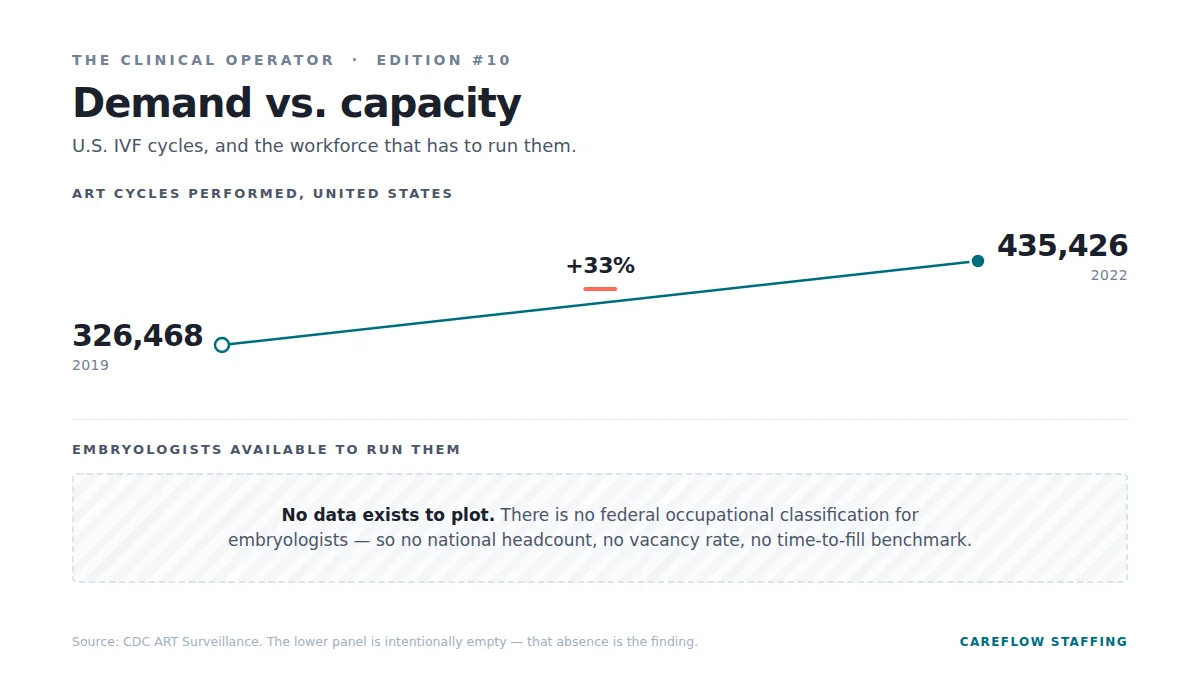
The workforce nobody is counting.
There is no published Bureau of Labor Statistics occupational classification for embryologists.
Sit with what that means operationally: no authoritative national headcount, no reliable vacancy rate, no time-to-fill benchmark, and no clean way for a clinic to know whether its staffing is normal or dangerously thin.
Two things have tightened supply further. A high-complexity laboratory director rule that took effect December 28, 2024 raised the credential requirements for the HCLD role, shrinking the pool of people who can legally direct a lab.
And HCLD compensation has been reported in the $400,000–$600,000 range with $50,000–$100,000 sign-on bonuses. Markets don’t pay that for abundant labor.
Meanwhile, 62% of U.S. embryologists report high exhaustion, and roughly 80% work overtime. In a role where a single procedural error is irreversible, that’s a risk-management issue, not a morale one.
How the ceiling shows up.
It rarely announces itself. It presents as symptoms that get individually explained away:
- Stimulation protocols start bending around lab availability rather than clinical optimum. Nobody frames it that way; it’s ‘we’re just really booked.’
- Batching creeps in. Retrievals cluster on certain days because that’s when coverage exists. A deliberate model is fine; one that emerges by accident is a warning.
- Weekend coverage becomes a negotiation. Biology doesn’t observe the calendar.
- Turnaround on results stretches. Then patient reporting slips, then experience scores dip, then somebody proposes a patient-experience initiative which does not address the cause.
- One person can legally direct your lab, and one or two can do certain procedures competently. That’s not a staffing model; it’s an unhedged position that has never been priced.
Where a staffing partner can and can’t help.
Start with the limit, because it matters: CareFlow does not place embryologists. No agency is handing you an HCLD next month, and any partner implying otherwise is selling rather than diagnosing.
What we do place is the other half of a retrieval day…CRNAs and perioperative RNs. And that distinction is worth drawing, because the two constraints look identical from the outside and have completely different fixes.
A retrieval window can’t move. Biology sets the clock; a cycle ready on Saturday is ready on Saturday. That makes fertility programs uniquely exposed to coverage variability…a hospital can slide an elective case to Tuesday, and you can’t.
You’re also competing for the same shrinking anesthesia pool as every ASC in your market, with less schedule flexibility than any of them.
So before concluding the lab is your ceiling, check whether the room is. If retrievals are batching around anesthesia availability rather than embryologist availability, that’s a coverage problem wearing a capacity problem’s clothes, and it’s the cheaper of the two to solve.
That’s what CareFlow is built for: perioperative RNs and CRNAs across California, with the employer-side work; payroll tax filings, workers’ comp, benefits compliance are handled by a dedicated backoffice partner.
It’s what lets my time go into matching the same clinicians to your retrieval days instead of into administration.
Continuity matters more here than almost anywhere: a team that has run your protocol before is not the same thing as a filled shift.
If you’re at 95% of capacity, more marketing spend does not produce more cycles.
It produces longer wait times, more batching, more overtime, and a faster path to losing the person you cannot replace in under six months. Fertility looks like a marketing business and runs like a capacity one.
Three questions, ten minutes.
1. What share of last quarter’s retrievals were scheduled around staff availability rather than clinical optimum?
Uncomfortable to measure, and the single most diagnostic number you have.
2. Of those, how many traced to the lab and how many to the room?
This is the question that tells you which ceiling you’re actually hitting.
3. If your lab director resigned with standard notice, what is the specific plan?
If the answer involves a call you haven’t made, that’s the answer.
One more worth raising with counsel rather than solving alone: staff working long, non-interruptible procedural blocks create real California meal-and-rest-period exposure. Worth a review before it becomes a finding.
Coming up in 12: a new vertical — what happens when independent aesthetic practices go up against PE-backed consolidators, and why the fight is decided by retention.
Run the three questions and tell me what came back. I’d rather compare notes than pitch anything. If the honest answer is ‘your capacity is fine, go spend on marketing,’ that’s a perfectly good outcome.
Reply here or book 15 minutes.”
Stay informed with the latest updates in fertility and reproductive medicine on Fertility News.
-
Sep 16, 2026, 19:19What’s the Difference Between IUI and IVF? – Caperton Fertility Institute
-
Sep 16, 2026, 19:18Michal Kubis: Will Fertility Tech Actually Reverse Population Collapse?
-
Sep 16, 2026, 19:15Caroline Biddle: What Does Good Fertility Support Look Like in Your Organisation?
-
Sep 16, 2026, 19:1112 Important Fertility Tests and When They Are Done – Valley Fertility Centre
-
Sep 16, 2026, 19:04Rafael González: Sharing Days of Science and Reuniting with Good Friends at SAMeR2026
-
Sep 16, 2026, 18:56Saadat Hassan: Fathers’ Age Changes Sperm, but Does It Change the Embryo?
-
Sep 16, 2026, 18:53Carmen Mair: 5 Fertility Tests Often Missed
-
Sep 16, 2026, 18:50ESHRE Campus 2026, Comprehensive Approaches to Pregnancy Loss – ESHRE SIG Reproductive Genetics
-
Sep 16, 2026, 18:42Igbashio Faith: Do You Actually Know When You’re Most Fertile?