

Madhur Hamine: Why IVF Success Rates Without Denominator Clarity Can Be Misleading?
Madhur Hamine, Business Consultant at IVF Business Consulting, shared a post on LinkedIn:
“‘78% IVF Success Rate’
A scientifically incomplete statement… unless properly defined.
In ART practice, outcome reporting without denominator clarity can be misleading.
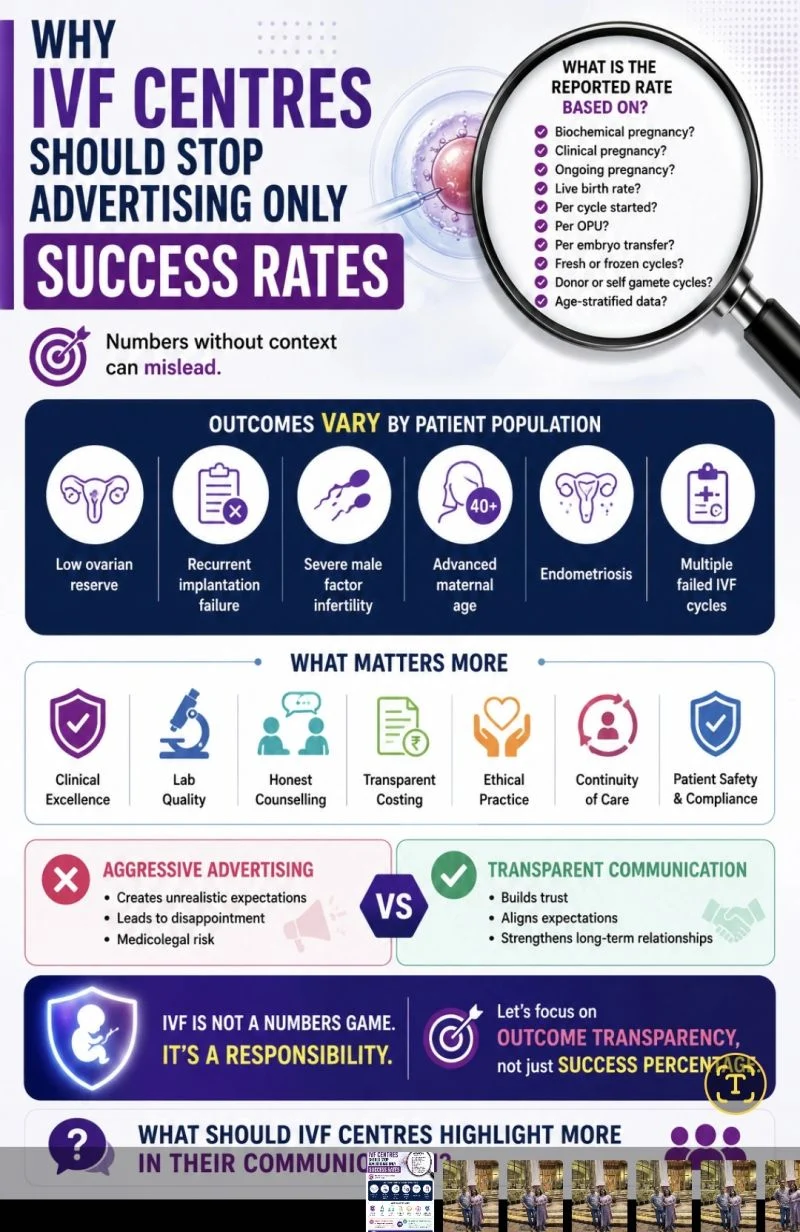
Is the reported rate based on:
- Biochemical pregnancy?
- Clinical pregnancy?
- Ongoing pregnancy?
- Live birth rate?
- Per cycle started?
- Per OPU?
- Per embryo transfer?
- Fresh or frozen cycles?
- Donor or self gamete cycles?
- Age-stratified data?
A centre treating predominantly good prognosis patients will naturally report different outcomes compared to centres handling:
- Low ovarian reserve
- Recurrent implantation failure
- Revere male factor infertility
- Advanced maternal age
- Endometriosis
- Multiple failed IVF cycles
Globally, mature ART ecosystems are gradually shifting toward:
- Standardized reporting
- Patient-category stratification
- Cumulative live birth analysis
- Transparency in inclusion criteria
- Counselling-based communication rather than purely promotional metrics
From a medicolegal and ethical standpoint, aggressive success-rate-centric advertising may also create expectation mismatch in infertile couples.
In IVF practice, clinical governance, laboratory quality systems, patient selection, counselling standards, complication rates, compliance protocols and continuity of care are equally important quality indicators.
Perhaps the next evolution in IVF communication should be:
‘Outcome Transparency’ rather than isolated ‘Success Percentage’.
Your thoughts on standardising IVF outcome reporting in India?”
Kiran Doltade, Business Head at Oospheere IVF Services Pvt Ltd, shared Madhur Hamine’s post, adding:
“An important perspective for today’s IVF ecosystem.
IVF success rates without proper context, denominator clarity, and patient stratification can often be misleading. Every centre manages different patient profiles, making transparent outcome reporting far more important than isolated percentages.
The focus should move toward ethical communication, realistic counselling, laboratory quality, and cumulative live birth outcomes rather than only promotional success rates.
True trust in ART practice comes from transparency.”
Stay updated on all scientific advances in the field of fertility with Fertility News.
-
Oct 8, 2026, 17:18Khalil Faaed: Vitrification Prevents Ice, but Does It Prevent Oocyte Damage?
-
Oct 8, 2026, 17:16Ritu Anand: Better Conversations Ultimately Lead to Better Care in Fertility
-
Oct 8, 2026, 17:14Mark Trolice: Excited to Speak at Women’s HealthX
-
Oct 8, 2026, 17:12Delighted to Welcome Dr. Róisín Mortimer – Waterstone Clinic-IVF and Fertility
-
Oct 8, 2026, 17:09Deirdre Zander-Fox: Pleased to Be an Invited Speaker at ESHRE Precision ART
-
Oct 8, 2026, 17:06Roohi Jeelani: Is Modern Life Actually Making It Harder to Get Pregnant?
-
Oct 8, 2026, 17:04Robert Borowczyk: We Judge the Newest IVF Consultation Group Too Quickly…
-
Oct 8, 2026, 17:01Carlos Guerrero: Great Couple of Days Visiting the Team at New Leaders in Fertility and Endocrinology
-
Oct 8, 2026, 17:00Sarah Banks: Improving Patient Experience Isn’t Always About Making Huge Changes…