

Kothwal Zabeen: PCOD – Understanding Symptoms, Ovulation, Fertility and Management
Kothwal Zabeen, Research and Documentation Intern at Clinivance TechLabs, shared on LinkedIn:
“PCOD: Understanding Symptoms, Ovulation, Fertility, and Management.
Women’s health deserves more awareness, understanding, and evidence-based information.
PCOD is a commonly used term in conversations about ovarian health, menstrual irregularities, hormonal changes, and fertility. But how much do we really know about its symptoms, contributing factors, and management?
In this article, we explore the commonly discussed symptoms, the relationship between ovulation and fertility, lifestyle management, medical care, and the important distinction between PCOD and PCOS.
What you will learn:
- Common symptoms and contributing factors
- How irregular ovulation may affect fertility
- Lifestyle habits that support overall health
- The role of medical evaluation and treatment
PCOD vs PCOS: Understanding the terminology
My aim is to make healthcare information easier to understand and encourage women to seek appropriate medical guidance when needed.
Let’s create more awareness about women’s reproductive health through education, understanding, and evidence-based information.
Disclaimer: This article is for educational purposes only and is not a substitute for professional medical advice, diagnosis, or treatment.
PCOD: Understanding the Condition Beyond Irregular Periods.
PCOD: Polycystic Ovary Disease.
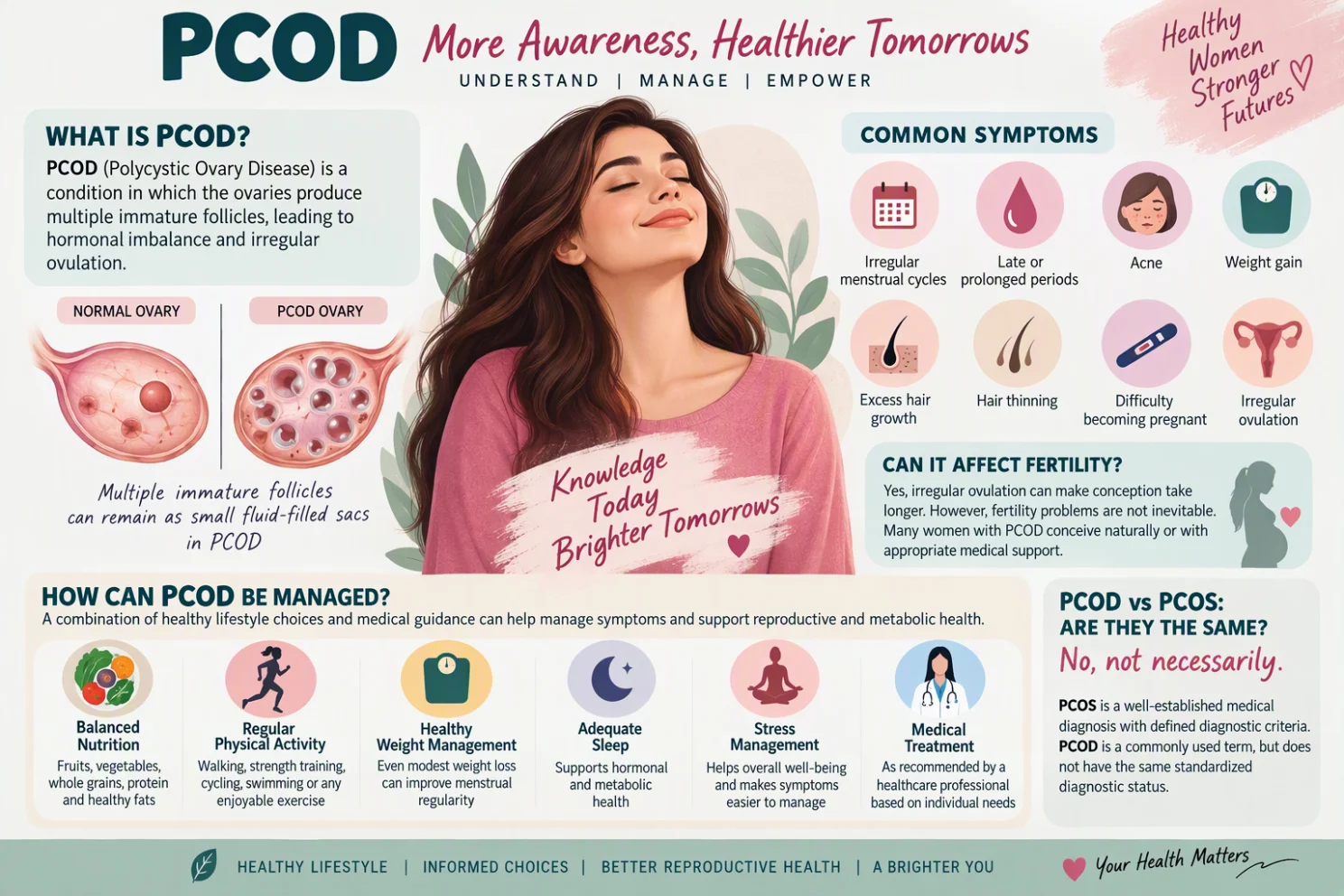
Polycystic ovary disease is a term commonly used to describe a condition in which the ovaries produce multiple immature follicles, and ovulation becomes irregular.
PCOD is frequently discussed along with PCOS, but the two terms are not interchangeable.
Understanding what PCOD means, why it will occur and the medical care will help is the important for the women’s reproductive health.
What is PCOD?
PCOD is commonly used to refer to polycystic ovary disease.
In this condition, the ovaries release immature eggs, which can remain as small, fluid-filled follicles. This will contribute to hormonal imbalance and irregular ovulation.
This result will changes in the menstrual cycles and in some women there will be difficulties with the conception.
It is very important to note that the terminology which is around the PCOD is less standardized in the modern medical practice than the PCOS.
Many of the people will use the term PCOD when referring to the symptoms or the ovarian findings that will actually fall under the PCOS.
What contributes to PCOD?
The exact cause is not clear.
Some of the possible factors are:
- Hormonal imbalance.
- Genetic Factors.
- Poor Diet.
- Physical Inactivity.
- Weight Gain.
- Stress.
- Disturbed Sleep Patterns.
- Metabolic Changes.
PCOD is not to be viewed simply as a condition caused by eating unhealthy food.
Biological and genetic factors will also play important roles.
Symptoms:
- Irregular menstrual cycles.
- Late periods.
- Heavy or prolonged periods in some cases.
- Difficulty in Ovulation.
- Acne.
- Weight Gain.
- Excess hair growth in some women.
- Hair thinning.
- Difficulty becoming pregnant.
PCOD and Ovulation:
Normal ovulation involves the release of a mature egg from the ovary.
When ovulation becomes irregular, periods will become irregular, periods will become unpredictable. Irregular ovulation will also make the conception more difficult because there may be the fewer opportunities for the egg that is to be released.
However, irregular ovulation will not automatically mean infertility. Many of the women with the irregular cycles will conceive, either naturally or with the appropriate the medical support.
Can PCOD affect fertility?
It will.
If ovulation does not occur regularly, then conception will take longer.
However, fertility problems are not inevitable.
Depending on the underlying cause, healthcare professionals will recommend lifestyle changes, monitoring of ovulation, medicines, or fertility treatment.
How can PCOD be managed?
Management usually focuses on improving the symptoms and also supporting reproductive and metabolic health.
- Balanced Nutrition: A balanced diet contains vegetables, fruits, whole grains, protein sources and healthy fats that can support overall health.
- Regular Physical Activity: Walking, Strength, training, cycling, swimming or the other enjoyable forms of the exercise that will improve overall metabolic health.
- Healthy Weight Management: For women who are overweight, even modest weight loss will improve menstrual regularity and metabolic health.
- Adequate Sleep: Poor sleep will negatively affect overall hormonal and metabolic health.
- Stress Management: Long-term stress will affect overall well-being and also make the existing symptoms that are harder to manage.
- Medical Treatment: If symptoms are significant, a healthcare professional will recommend medicines depending on the individual’s menstrual, hormonal, metabolic state.
PCOD vs PCOS: Are they the same?
No, not necessarily.
- PCOS is a well-established medical diagnosis that was recognized by the diagnostic criteria and that can involve reproductive, hormonal and the metabolic abnormalities.
- PCOD is a term that is commonly used in everyday conversation, but it does not have the same standardized diagnostic status.
Conclusion:
PCOD is to be often discussed as it is simply an ovarian problem but the menstrual and the reproductive health that can be influenced by the many different factors.
Instead of the fearing of the diagnosis, the focus that should be on the understanding the underlying cause, identifying of the symptoms, and receiving the appropriate care.
A healthy lifestyle will support the hormonal and the metabolic health but the lifestyle changes should be complement but not to replace the medical evaluation when the symptoms will persist.”
Stay informed with the latest updates in fertility and reproductive medicine on Fertility News.
-
Oct 26, 2026, 17:12Dilpreet Banwait: Could Our IVF Laboratory Consumables Be Introducing Microplastics into Sperm Samples?
-
Oct 26, 2026, 17:05Yashpal Singh Rao: IVF Care Should Adapt to Patients’ Lives, Not Expect Patients to Adapt
-
Oct 26, 2026, 16:57Zeinab Kazemianpour: Fresh or Frozen Embryo Transfer
-
Oct 26, 2026, 16:52Sean Lauber: IVF Birthweights Catching Up to the General Population
-
Oct 26, 2026, 16:43Sanketh Dhumal Satya: The S Value Paradox – The Curious Case of Sperm Size
-
Oct 26, 2026, 16:25Laura Rienzi: My Lab in 2012 – GENERA Center Was Born
-
Oct 26, 2026, 16:08Mina Popovic: Last Week I Had the Pleasure of Giving Two Talks at the 9th ART Fertility Conference
-
Oct 26, 2026, 16:04Rajeev Agarwal: “Unexplained” Infertility – 3 Numbers Worth Knowing
-
Oct 26, 2026, 16:01Margaret Cali: Dear Brave Soul, a Gentle Reminder for This Week