

Mazen Al-Obaidi: How the Placenta Talks to the Baby’s Brain
Mazen Al-Obaidi, Assistant Professor in Biomedical Sciences at University of Technology and Applied Sciences, shared a post on LinkedIn:
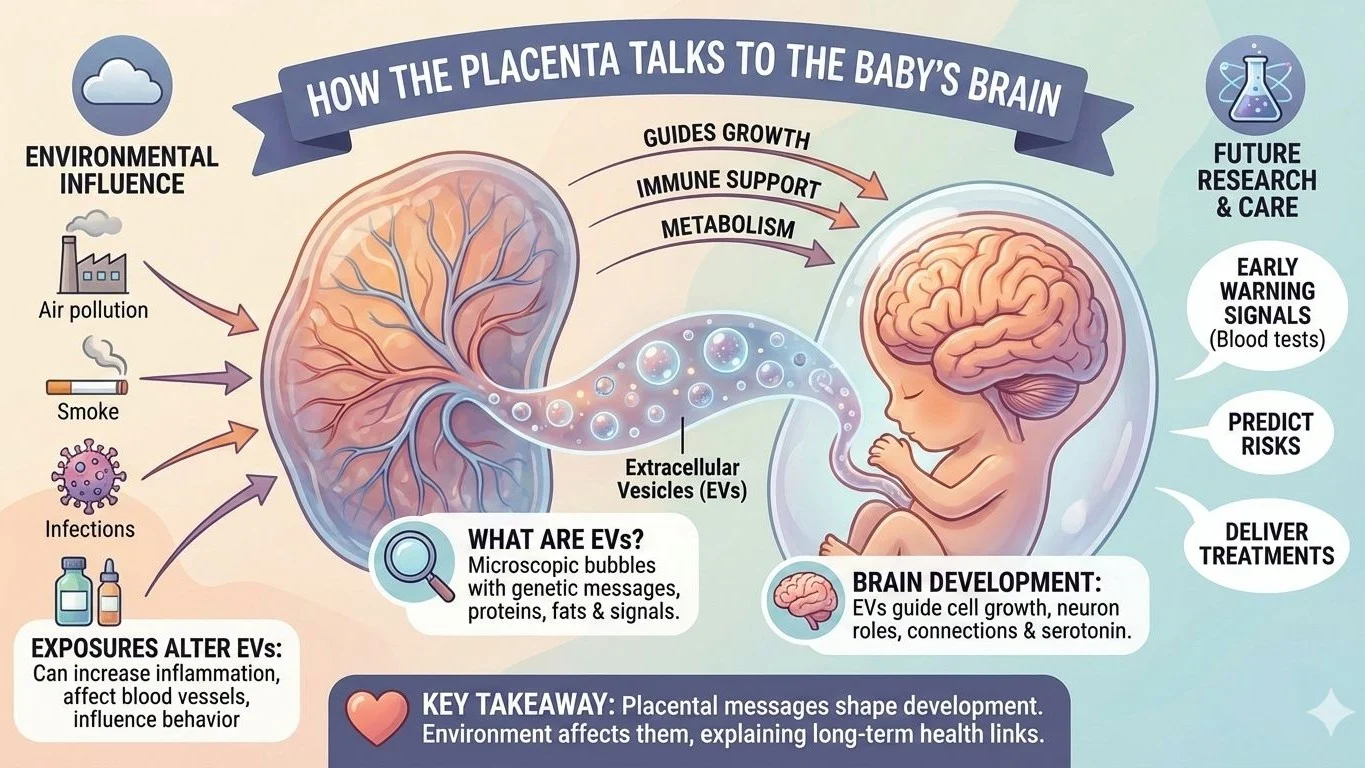
“How the Placenta Talks to the Baby’s Brain
During pregnancy, the placenta is not just a bridge for nutrients and oxygen—it also sends tiny biological messages to the baby and the mother.
These messages are carried in very small particles called extracellular vesicles (EVs).
What are placental extracellular vesicles?
- EVs are microscopic bubbles released mainly from placental cells.
- They carry important information such as genetic messages, proteins, fats, and chemical signals.
- These vesicles travel through the blood and can reach many organs, including the baby’s brain.
Why are they important?
- EVs help the mother’s body accept and support the pregnancy.
- They guide the baby’s growth and organ development, including the heart, lungs, kidneys, and brain.
- They help control how the baby’s immune system and metabolism develop.
EVs and brain development
- Some placental EVs can cross into the baby’s brain.
- They influence how brain cells grow, decide their roles (neurons or support cells), and form connections.
- Certain EVs even carry serotonin, a chemical important for brain development and mood regulation later in life.
How the environment affects these messages?
Things a mother is exposed to during pregnancy can change these placental messages, such as:
- Air pollution
- Infections
- Cigarette smoke
- Chemical pollutants
These exposures may alter EVs in ways that:
- Increase inflammation
- Affect blood vessel formation
- Influence brain development and behavior in childhood
- In some cases, EVs may even try to protect the baby from harmful exposures—but sometimes the changes can be harmful.
Why this research matters?
- EVs could become early warning signals, helping doctors detect pregnancy problems before symptoms appear.
- A simple blood test might one day help predict risks to a baby’s brain development.
- Scientists are also exploring whether EVs could be used to deliver treatments safely to the fetus.
What’s next?
- More research is needed using human-based models to confirm findings.
- Scientists want to better understand which messages help and which harm the developing baby.
- Standard methods are needed before EVs can be used in clinics.
Key takeaway
The placenta sends powerful microscopic messages that help shape a baby’s development. These messages can be influenced by the environment, offering a scientific explanation for how pregnancy conditions affect long-term child health—especially brain development.
Source.”
Title: Placenta-derived extracellular vesicles in fetal health: emerging insights into brain development and environmental interactions
Authors: Ethan Lewis, So Jeong Lee, Hae-Ryung Park
Stay updated on all scientific advances in the field of fertility with Fertility News.
-
Sep 13, 2026, 15:11Sachintha Alwis: From Impaired Sperm Motility to Microrobotics
-
Sep 13, 2026, 15:08Laurence Orbuch: Before Endometriosis Surgery, Ask…
-
Sep 13, 2026, 15:05Ademola Ayodele: IUI, IVF or Egg Freezing – Which One Is Right for You?
-
Sep 13, 2026, 14:59Fiona Pathiraja-Møller: Tennis Players No Longer Have to Choose Between Career and Family
-
Sep 13, 2026, 14:571-Day Virtual Experience for People Impacted by PMOS – PCOS Awareness Association
-
Sep 13, 2026, 14:53Ozor Victor: Behind Every Embryo Is a Story of Science, Precision, and Hope
-
Sep 13, 2026, 14:50Diana Kayal: What They Don’t Tell You About IVF
-
Sep 13, 2026, 14:44Vikram Sinai Talaulikar: A Heartfelt Thank You to All Who Donated and Supported “Menopause and Cancer”
-
Sep 13, 2026, 14:41Nicole McPherson: Changing IVF Practices Is Hard – Integration Needs to Be Easy