
Amos Grünebaum: The Riskiest Day of Pregnancy Is the Day Everyone Stops Watching
Amos Grünebaum, Professor of Obstetrics and Gynecology at Donald and Barbara Zucker School of Medicine, shared on LinkedIn:
“During pregnancy, a woman with routine prenatal care is seen a dozen times or more.
- Blood pressure at every visit.
- Urine tests. Blood tests.
- Ultrasounds.
- Questions about swelling, headaches, movement. If anything looks slightly off, someone calls her back.
Then she gives birth.
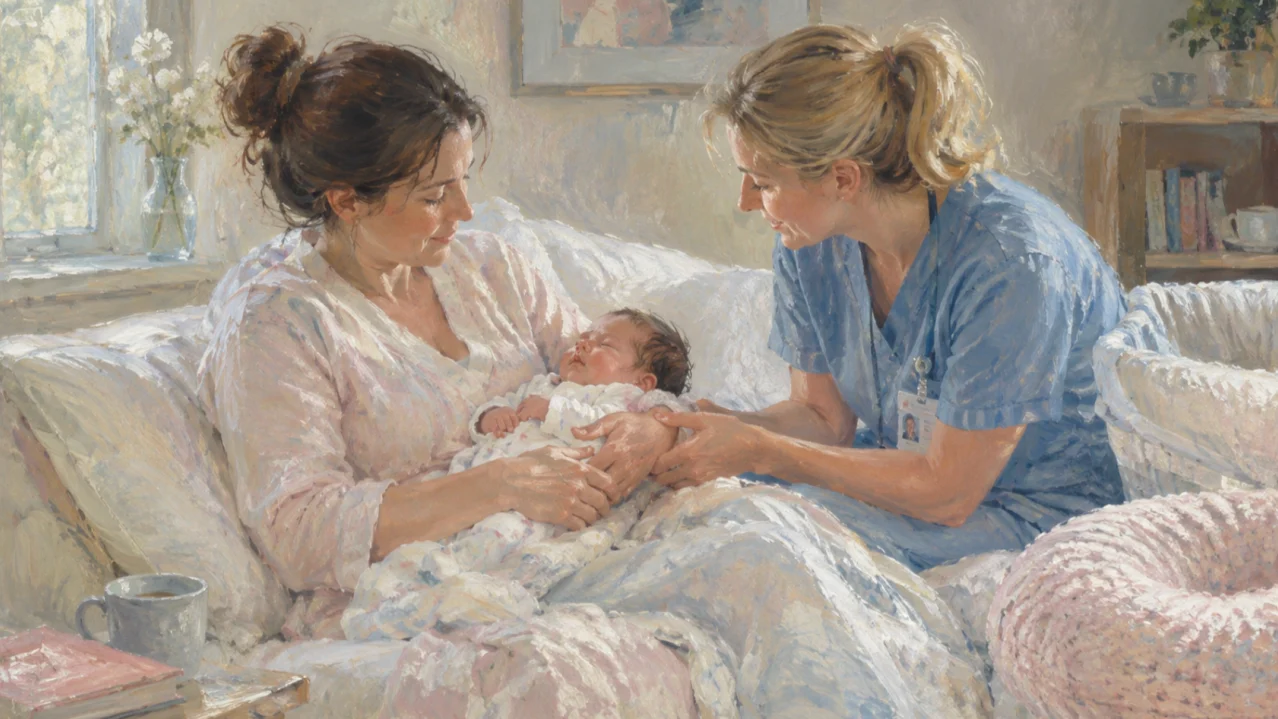
Within a day or two, she is discharged. Her baby will be seen by a pediatrician within days, then again and again over the following weeks.
The mother’s next OB appointment is six weeks away.
She doesn’t even know much about when to call the hospital or clinician.
That is why I developed a tool to help close the gap.
While in Europe, a nurse will come to visit her regularly at home soon after delivery, that is non-existent in the US. Despite the high maternal mortality rates, the US hasn’t implemented a system to prevent postpartum mortalities. That is a fault of both politicians and our professional organizations
In more than 50 years of obstetrics, I have watched us build one of the most intensive surveillance systems in all of medicine for the nine months of pregnancy, and then dismantle it on the one day the data tell us the danger is far from over.
This article is about that gap, and about the numbers behind it that most new mothers are never told.
I built a tool to help postpartum women fill some of that gap.
When Mothers Actually Die
The Centers for Disease Control and Prevention reviews maternal deaths through state committees that examine each case in detail. Their report covering 2017 to 2019, spanning more than 1,000 pregnancy-related deaths across 36 states, found something that should have changed how we practice.
Only 22 percent of pregnancy-related deaths happened during pregnancy itself, the period when we watch women most closely. Another 25 percent happened on the day of delivery or in the first week after. And 53 percent, more than half of all pregnancy-related deaths, happened between one week and one year after the birth.
Read that again.
The majority of mothers who die from pregnancy die after the pregnancy is over, in the window when the appointments have stopped, the monitoring has stopped, and everyone, including the health care system, has turned its attention to the baby.
One more number from the same report: the committees judged more than 80 percent of these deaths preventable. Not tragic and unavoidable. Preventable.
What Kills Mothers After They Go Home
The dangers change as the weeks pass. In the first days, the leading threats are severe bleeding, infection, and blood pressure disorders such as preeclampsia, which can appear for the first time after delivery, a fact many women are never told. Blood clots that travel to the lungs are a threat throughout.
Later in the first year, heart muscle disease called cardiomyopathy becomes a leading cause. And across the entire period, the single most frequent underlying cause of pregnancy-related death in the CDC review was mental health conditions, including suicide and overdose, accounting for about 23 percent of deaths with a known cause.
Think about what that means. The most common way a new mother dies from pregnancy in America is a mental health condition, and our standard of care asks her to hold on for six weeks before anyone from obstetrics looks her in the eye and asks how she is doing.
The Six-Week Fiction
Where does the six-week visit come from?
Not from evidence.
It is a tradition, roughly matching the time it takes the uterus to return to its usual size. It answers an anatomical question. It does not answer the clinical one, which is: when do problems appear?
The data say problems appear on day 3, day 10, day 40, and day 200.
To its credit, the American College of Obstetricians and Gynecologists rewrote its guidance in 2018, calling for contact with every mother within the first three weeks and describing postpartum care as an ongoing process rather than a single visit. That was the right direction.
But guidance on paper is not surveillance in practice. ACOG’s own publication acknowledged that as many as 40 percent of women do not attend a postpartum visit at all. A recommendation that reaches 60 percent of mothers is not a safety net. It is a suggestion.
Meanwhile, her baby will typically be examined several times before the mother is examined once. We schedule the newborn relentlessly and the mother optimistically.
Moving the Visit Earlier Misses the Point
When this gap is discussed, the usual proposal is to see postpartum patients in the office earlier than six weeks. Two weeks instead of six. Three. It sounds like progress, and it is better than nothing. But it quietly keeps the worst feature of the old model: it puts the burden of surveillance on the patient.
Think about who we are asking to come in. A woman days out from birth, or from major abdominal surgery, bleeding, exhausted, feeding a newborn around the clock, often without childcare for her other children, without transportation, without paid leave. The mothers least able to get to an office are precisely the mothers at highest risk. An earlier appointment she cannot attend protects her exactly as well as a later one, which is to say, not at all.
Europe Solved This Decades Ago
Countries with far lower maternal mortality do not ask the mother to come to the system. They send the system to the mother.
In the Netherlands, a trained maternity nurse comes to the home every day during the first week after birth, checking the mother’s bleeding, blood pressure, wound, and mood while helping with the baby. In Germany, insurance covers home visits by a midwife starting right after discharge and continuing for weeks. In the United Kingdom, a midwife visits at home in the first days, followed by a health visitor. Nobody asks a woman five days out from a cesarean to find parking.
These are countries where maternal mortality is more than 50 percent lower than in the United States; in several of them, it is lower by far more than that. Home visiting is not the only reason – universal coverage matters enormously – but the pattern repeats in every one of them: in the weeks after birth, a trained professional lays eyes on the mother, in her home, starting in week one. In America, in most places, no one does.
Why the Gap Persists
Follow the money and the gap explains itself. Obstetric care in the United States is commonly paid as one global fee covering prenatal visits, the delivery, and a postpartum visit. Once the baby is delivered, nearly all of that fee has been earned. Every additional postpartum contact is effort without payment attached.
Insurance coverage compounds it. Medicaid pays for roughly 4 in 10 American births, and for decades its pregnancy coverage ended 60 days after delivery, just as the late deaths were beginning.
Most states have now extended postpartum Medicaid coverage to a full year, a genuine improvement. But coverage only helps if there are appointments to cover, and our care model still treats week 6 as the finish line.
None of this requires villains. It requires only a system in which nobody is specifically responsible for the mother between the delivery bill and the six-week visit. Responsibility that belongs to everyone belongs to no one.
What Every New Mother Should Know
Until the system changes, information is protection. These warning signs after birth deserve immediate medical attention, not a wait-and-see: severe headache that does not go away, changes in vision, chest pain, trouble breathing, heavy bleeding that soaks through a pad in an hour, a swollen or painful leg, fever, a wound that is not healing, and thoughts of harming yourself or your baby.
None of these is a normal part of recovery. Every one of them is a reason to call, today, and to say the words ‘I gave birth recently.’ That sentence changes how seriously symptoms are taken, and it can save your life.
And if you feel that something is wrong but cannot name it, that counts too. In the death reviews, one missed opportunity appears over and over: a woman reported symptoms, and nobody connected them to her recent birth.
My Take
We do not have a maternal mortality problem so much as a maternal attention problem.
We proved we can watch closely; we do it for nine months.
Then, on the day the risk of dying shifts decisively toward the mother, we hand her a follow-up card and turn to the crib.
The answer is not an earlier appointment. The answer is a nurse or midwife at her door in the first week, as much of Europe has done for decades.
A blood pressure check and a mental health screen that come to her, not the other way around.
A comprehensive visit that adapts to her, not to the calendar.
I also built a tool to assess whether what a postpartum woman experiences is normal or not.
Payment that treats postpartum care as care rather than as an epilogue. None of this is beyond a country that can monitor a fetal heartbeat from a phone.
Pregnancy does not end at delivery. It ends when the mother is safe. Our system should stop watching when the risk stops, not before.”
Other articles featuring Amos Grünebaum on Fertility News.
-
Oct 21, 2026, 17:57Ula Sankowska: What I’ll Bring to ASRM INNOVATE in Baltimore
-
Oct 21, 2026, 17:40Robert Borowczyk: The Invisible Waiting Room
-
Oct 21, 2026, 17:35Fereshteh Safian: Behind the Scenes of Reproductive Medicine
-
Oct 21, 2026, 17:20The Relationship Between Trophectoderm Biopsy and Early Pregnancy Outcomes – RBMO
-
Oct 21, 2026, 17:09Jules McDonald: The Future of Fertility Is Happening in Abu Dhabi
-
Oct 21, 2026, 16:53Ashley Evans: I Never Imagined I’d Be a Fertility Story with a Group of People Whom I Have Never Met…
-
Oct 21, 2026, 16:41Karthik Raj: Asherman’s Syndrome – When the Endometrium Cannot Regenerate Normally
-
Oct 21, 2026, 16:36Katy Encalade: A Few Misconceptions I Think Every Woman Considering Egg Donation Deserves to Understand
-
Oct 21, 2026, 16:21The FeRGI Working Group 2026-2027 – ESHRE SIG Reproductive Genetics