

Samer R. Hammoudeh: Which Came First, the Stem Cell or the Egg?
Samer R. Hammoudeh, IVF Lab Director at Fakih IVF Fertility Center, shared on LinkedIn:
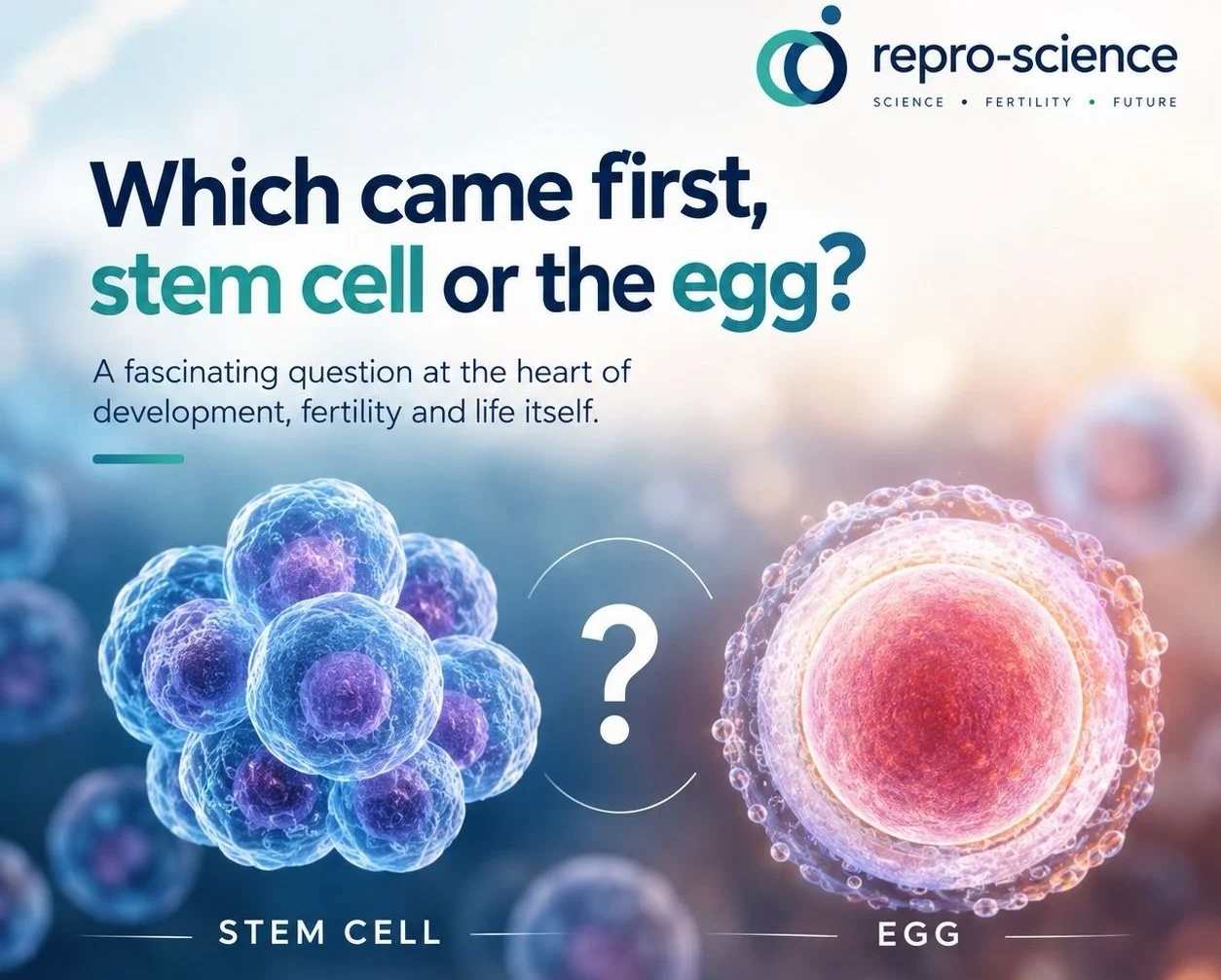
“Which came first, the stem cell or the egg?
A fascinating question at the intersection of stem cell biology, embryology, and reproductive medicine.
We often think of the egg as the beginning of life.
But from a developmental biology perspective, the story is much more complex.
The egg is not the beginning of cellular life – but it is the beginning of a remarkable developmental journey.
Let’s explore the science.
The egg: More than just a cell.
The human oocyte is a highly specialized cell containing maternal genetic material, cytoplasmic components, mitochondria, and molecular machinery essential for the earliest stages of development.
Following fertilization, the oocyte and sperm contribute genetic material to form the zygote.
This single cell begins a tightly coordinated sequence of divisions, eventually giving rise to the blastocyst.
The stem cell: The potential to become many cell types.
Stem cells are defined by their ability to self-renew and, depending on their type, differentiate into specialized cells.
During early embryonic development, cells of the inner cell mass of the blastocyst give rise to embryonic stem cell lines.
These cells are pluripotent, meaning they can generate almost all cell types of the body.
However, an important distinction exists: the fertilized egg and early embryo are not simply equivalent to embryonic stem cells.
They represent different biological states with distinct developmental properties.
What does this mean for IVF and reproductive science?
In the IVF laboratory, we witness this extraordinary transition every day – from fertilization to cleavage, compaction, blastocyst formation, and cellular differentiation.
Understanding the relationship between oocytes, early embryonic cells, and stem cells has implications far beyond IVF, including:
- Improving our understanding of early human development.
- Investigating the biological mechanisms underlying infertility and early pregnancy loss.
- Advancing regenerative medicine and disease modelling.
- Exploring emerging approaches to reproductive biology, including research into gamete-like cells derived from stem cells.
The latter remains an active research area, with substantial scientific, safety, ethical, and regulatory challenges before any potential clinical application.
So, which came first?
- If we mean the first cell in an individual human developmental journey, the answer is the zygote, formed after fertilization.
- If we mean which cellular system existed first in the evolutionary history of life, the answer is neither the modern mammalian egg nor the stem cell as we know it today.
Life and cellular reproduction evolved long before these specialized cell types emerged.
Perhaps the most interesting question is not which came first, but how one cell acquires the remarkable capacity to generate an entire human organism.”
Other articles featuring Samer R. Hammoudeh on Fertility News.
-
Oct 26, 2026, 17:12Dilpreet Banwait: Could Our IVF Laboratory Consumables Be Introducing Microplastics into Sperm Samples?
-
Oct 26, 2026, 17:05Yashpal Singh Rao: IVF Care Should Adapt to Patients’ Lives, Not Expect Patients to Adapt
-
Oct 26, 2026, 16:57Zeinab Kazemianpour: Fresh or Frozen Embryo Transfer
-
Oct 26, 2026, 16:52Sean Lauber: IVF Birthweights Catching Up to the General Population
-
Oct 26, 2026, 16:43Sanketh Dhumal Satya: The S Value Paradox – The Curious Case of Sperm Size
-
Oct 26, 2026, 16:25Laura Rienzi: My Lab in 2012 – GENERA Center Was Born
-
Oct 26, 2026, 16:08Mina Popovic: Last Week I Had the Pleasure of Giving Two Talks at the 9th ART Fertility Conference
-
Oct 26, 2026, 16:04Rajeev Agarwal: “Unexplained” Infertility – 3 Numbers Worth Knowing
-
Oct 26, 2026, 16:01Margaret Cali: Dear Brave Soul, a Gentle Reminder for This Week