
Luteal Phase Progesterone Support in Modified Natural Cycle Frozen Embryo Transfer – RBMO
Reproductive BioMedicine Online (RBMO) shared a post on LinkedIn:
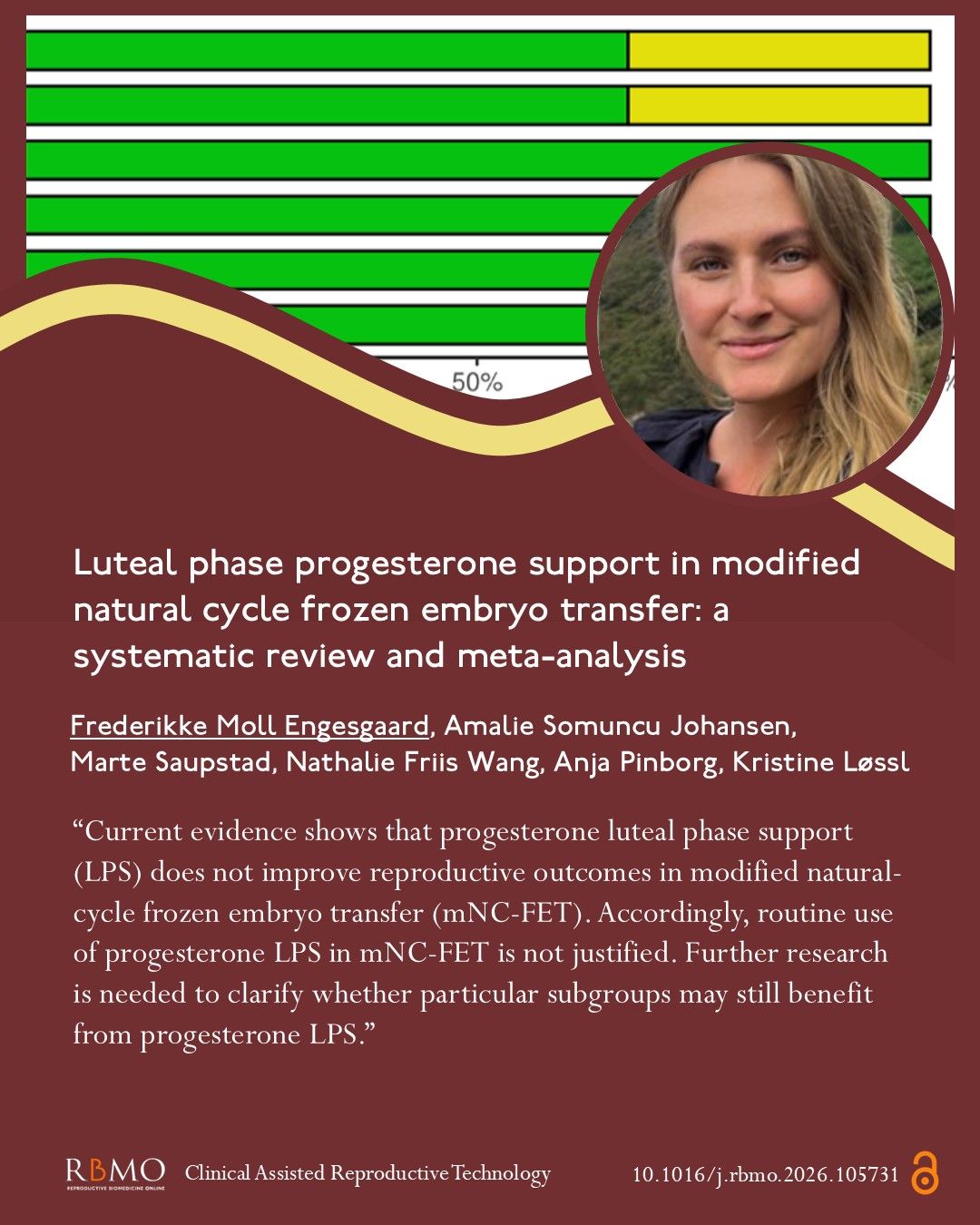
“The results of this Danish study indicate that progesterone luteal phase support (LPS) does not appear to be associated with increased live birth rate (LBR) in modified natural cycle frozen embryo transfer (mNC-FET).
Frederikke Moll Engesgaard and colleagues show that most women do not benefit from LPS in mNC-FET, implicating a need to revise current treatment protocols to avoid unnecessary use of medication associated with both physical discomfort and costs.
They show that some subgroups may benefit from progesterone LPS in mNC-FET; hence, it is advised that progesterone LPS should be considered as an individualized rather than routine treatment.
Published open access, the paper can be read in full for free from issue 53.2 now.”
Title: Luteal phase progesterone support in modified natural cycle frozen embryo transfer: a systematic review and meta-analysis
Authors: Frederikke Moll Engesgaard, Amalie Somuncu Johansen, Marte Saupstad, Nathalie Friis Wang, Anja Pinborg, Kristine Løssl

Stay updated on all scientific advances in the field of fertility with Fertility News.
-
Nov 18, 2026, 18:26Ritu Anand: We’ve Been Talking about Her Fertility – It’s Time to Talk about His
-
Nov 18, 2026, 18:20Sean Lauber: Is It Safe to Thaw and Rebiopsy an Embryo?
-
Nov 18, 2026, 18:14Arsiak Vartenian: 8 Years of Answering “Do You Have Kids?” Is a Long Time
-
Nov 18, 2026, 18:09Esther Eleboh: When the Same Protocol Produces Completely Different Embryo Outcomes
-
Nov 18, 2026, 18:05Resa Nabor: Having PCOS Doesn’t Make You Less of a Woman or Less Deserving of Love
-
Nov 18, 2026, 17:47Diana Kayal: Co-Chairing the 3rd International Conference on Gynecology and Women’s Health
-
Nov 18, 2026, 17:44Karthik Raj: Oocyte Quality Is Not Determined at Retrieval Alone
-
Nov 18, 2026, 17:41Tazeen Farhan: 10 Small Lifestyle Changes to Support Reproductive Health
-
Nov 18, 2026, 17:35Chanju Jung: Nature Paper Explores Base Editing in Human Embryos