
Oct 31, 2025, 14:35
Training Future Andrologists at Conceive Research and Art Bank – Conceive Research
Conceive Research shared a post on LinkedIn:
“Mastering DFI – one sample at a time!
Training future andrologists at CONCEIVE Research and Art Bank.
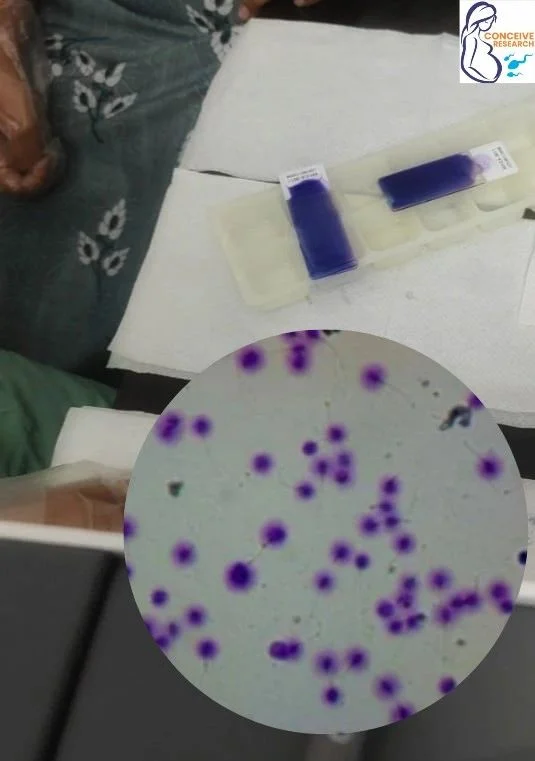
The Sperm Chromatin Dispersion (SCD) or Halo Test is a direct method used to assess the integrity of sperm DNA by observing the presence and size of a “halo” around the sperm head.
Key Principle
- Sperm with intact (non-fragmented) DNA will produce a large, diffuse loop of DNA that forms a distinct, bright halo surrounding the sperm head nucleus when treated with an acid and lysis solution.
- Sperm with fragmented (damaged) DNA lack the structural integrity to form these large loops, resulting in a small, poorly defined, or absent halo.
Clinical Significance
A high DFI (>30%) is associated with:
- Lower fertilization rates (in some cases).
- Poorer embryo quality and development.
- Increased risk of miscarriage (recurrent pregnancy loss).
- Failure of IVF/ICSI cycles.”
Stay updated on all scientific advances in the field of fertility with Fertility News.
-
Sep 21, 2026, 18:01Mostafa Maghraby: What Makes a Good Embryologist?
-
Sep 21, 2026, 17:57Paweł Radwan: Meeting Fertility Leaders at the European Executive and Investors Fertility Meeting
-
Sep 21, 2026, 17:49Anna David: Can You Predict Pregnancy Outcome at Diagnosis of Early-Onset FGR?
-
Sep 21, 2026, 17:44Caspian Ostadian: Oocyte Abnormalities and Blastocyst Formation
-
Sep 21, 2026, 17:40Eric Lameignere: What If Part of the Sperm DNA Damage We Observe is Actually Created in the IVF Laboratory Itself?
-
Sep 21, 2026, 17:29Angelo Tocci: Paying More Without Improving Assisted Reproduction Outcomes
-
Sep 21, 2026, 17:22Santiago Munne: The Latest Bpisode of The Baby Blueprint, About the Worldwide Decline in Birth Rates
-
Sep 21, 2026, 17:12Zeinab Kazemianpour: 1 Embryo, 2 Different Biopsy Strategies
-
Sep 21, 2026, 17:10Diksha Kanekar: A Day in the Life of an Embryologist