
Akansha Negi: An Embryo Is More Than Just a Cell Count
Akansha Negi, Trainee Embryologist at Akanksha IVF Centre at Mata Chanan Devi Hospital, shared on LinkedIn:
”An Embryo Is More Than Just a Cell Count
2-cell. 4-cell. 6-cell. 8-cell.
We often describe cleavage-stage embryos by their cell number. But have you ever looked closely at how those cells are distributed?
At the cleavage stage, blastomere size and symmetry can reveal the story behind the divisions.
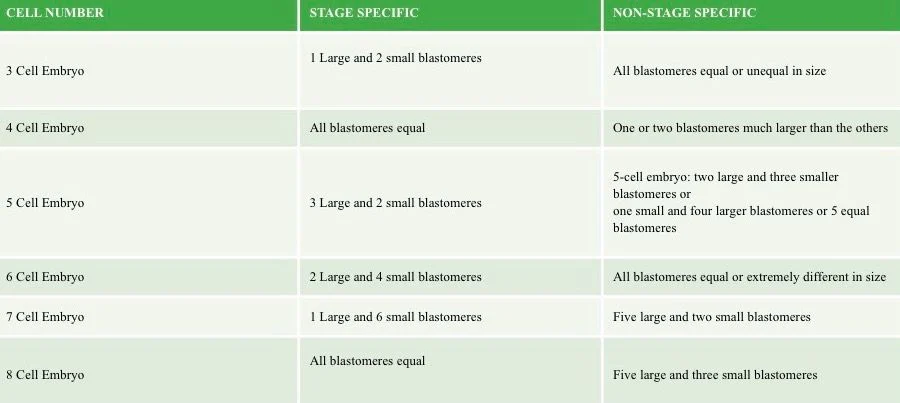
Interestingly, certain cell numbers have characteristic blastomere-size patterns:
- 3-cell embryo
Typically, 1 large + 2 small blastomeres - 4-cell embryo
Classically, 4 relatively equal blastomeres - 5-cell embryo
A stage-specific pattern may be 3 large + 2 small blastomeres - 6-cell embryo
2 large + 4 small blastomeres - 7-cell embryo
1 large + 6 small blastomeres - 8-cell embryo
Classically, 8 relatively equal blastomeres
But here’s where embryo morphology gets interesting.
Not every embryo follows the ‘textbook’ pattern.
A 5-cell embryo, for example, may also be seen with:
- 2 large + 3 small blastomeres
- 4 large + 1 small blastomere
- 5 relatively equal blastomeres
Likewise, a 7-cell embryo may show 5 large + 2 small blastomeres.
So, why does this happen?
Cleavage isn’t simply a perfectly synchronized sequence of:
1 – 2 – 4 – 8
Individual blastomeres can divide at different times, producing intermediate cell numbers and variations in blastomere size.
This is why looking at the embryo as simply ‘6-cell’ or ‘7-cell’ can miss part of the story.
The embryologist’s eye
When assessing a cleavage-stage embryo, we’re not just counting cells.
We’re asking:
- How many cells?
- How evenly are they divided?
- Is the size distribution appropriate for the stage?
- Is there significant fragmentation?
- Is multinucleation present?
- What does the overall cleavage pattern tell us about the embryo’s developmental history?
And with time-lapse imaging, this becomes even more fascinating because instead of seeing just a snapshot, we can observe how the embryo arrived at that particular cell number and morphology.
The cell count is the number.
The cleavage pattern is the story.”
Other articles featuring Akansha Negi on Fertility News.
-
Oct 22, 2026, 17:36Filipa Rafael: A Woman Should Not Have to Be Trying for a Baby for Her Ovarian Insufficiency to Matter
-
Oct 22, 2026, 17:30Michele Boiani: New Insight on Zona Pellucida Proteins
-
Oct 22, 2026, 17:01Sean Lauber: New Review Assesses PGT-A Effectiveness and Safety
-
Oct 22, 2026, 16:56Eric Lameignere: Optimizing Sperm Handling Conditions in the IVF Laboratory
-
Oct 22, 2026, 16:49Rajeev Agarwal: Most Failed IVF Transfers Are About the Embryo, Not the Uterus
-
Oct 22, 2026, 16:44Devyanshi Dixit: Calling for Delegates for GFWH 2026
-
Oct 22, 2026, 16:35Kate Ryder: Headed to ASRM 2026 and Looking Forward to Spending Time with Clinic Partners
-
Oct 22, 2026, 16:27Can PCOS/PMOS Increase the Risk of Premature Death? – PCOS Millennials
-
Oct 22, 2026, 16:18Margaret Cali: Before IVF Begins, a Lot of Preparation Happens…