
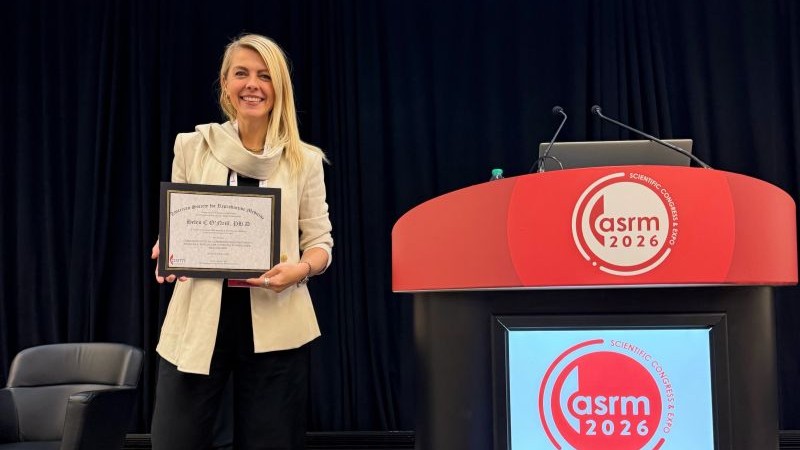
Helen O’Neill: Our Work Has Won the Prize Paper at the ASRM for the IRMSIG
Helen O’Neill, Founder and CEO of Hertility and Associate Professor in Reproductive and Molecular Genetics at UCL, shared on LinkedIn:
“Our work has won the Prize Paper at the American Society for Reproductive Medicine (ASRM) for the Imaging in Reproductive Medicine Special Interest Group (IRMSIG)!
I was proud to deliver two talks outlining both our diagnostic algorithms and ultrasound scanning work.
We all can see that AI is going to be central to the future of health, but when it comes to women’s health, things get difficult, because AI can only learn from data that exists (and we all know there is a depressing dearth of data on women’s bodies).
AI only earns its place in health if:
- it’s built safely,
- checked rigorously,
- and open about how it reaches its answers.
But most importantly, it has to be built on accurate, clinically labelled data (which we have in abundance at Hertility!)
Both my talks were about doing that properly.
Some context on why we built our AI pipeline for pelvic ultrasound.
At Hertility, women start with our detailed online health assessment followed by an at-home blood test, then very often a pelvic ultrasound.
Ultrasound is fundamental to gynaecological care, yet measurements vary depending on who performs the scan, there’s a global shortage of trained sonographers, and access to specialist expertise is deeply unequal.
So we built a five-stage AI pipeline that works on routine ultrasound images, which:
- Recognises which anatomy each image shows (7,700+ images; AUC 0.90-1.00)
- Identifies the viewing plane (AUC 0.96)
- Locates ovaries and follicles (5,400+ images, 32,000+ annotated structures; follicle AUC 0.98)
- Outlines the uterus, endometrium, ovaries and follicles (Dice 0.90 and 0.86)
- Calculates endometrial thickness, ovary volume and uterus volume automatically
Tested end-to-end in patients, the pipeline’s measurements correlated with manual measurements as strongly as two human methods correlate with each other (endometrial thickness.)
My second talk covered the step before the scan.
We trained a transparent Bayesian network on data to predict nine reproductive health conditions from symptoms, demographics, and up to 10 hormones.
- Endometriosis: AUC 0.97
- PCOS: AUC 0.92
- Menopause: AUC 0.997
For endometriosis, we had accuracy even without a blood test!
Every prediction comes with a probability and a credible interval, so clinicians can see how confident the model is.
Together, these projects aim to support women and clinicians at each step, from first symptoms to scan.
These were version one, and I can’t wait to share our updated findings.
Our hope, as always, is that data-driven technology like this can reduce clinical variability and help women get answers sooner.
This award belongs to the team: especially George Adams, who led the imaging work, alongside Natalie Getreu and Lorna Brightmore, and to James Bailey and everyone behind both projects.
Thank you to IRMSIG and ASRM for the award and recognition.”
Other articles featuring Helen O’Neill on Fertility News.
-
Nov 6, 2026, 18:05Harpreet Kehal: NIPT at 8 Weeks – Is It Ready for Practice?
-
Nov 6, 2026, 18:01Raouf Roshdy: Honored to Have Delivered My First Workshop in the Kingdom of Saudi Arabia at MEDGO 5
-
Nov 6, 2026, 17:58Dorit Kieslinger: Time-Lapse Imaging Does Not Improve Live Birth Rates
-
Nov 6, 2026, 17:48Khaled Abu Ali: What Is The One 1 Thing Your IVF Software Makes Harder Than It Should Be?
-
Nov 6, 2026, 17:37What Intended Parents Wish Their Clinics Explained Earlier About Donor Egg IVF – Fairfax EggBank
-
Nov 6, 2026, 17:33Vinesh Gadhia: 4 Months at Indira IVF, 34 Years in the Industry
-
Nov 6, 2026, 17:285 Questions Europe Is Still Asking About Fertility – IVI Fertility
-
Nov 6, 2026, 17:24The Future of Fertility Is… – Middle East Fertility Society
-
Nov 6, 2026, 17:20Phoebe White: A Few Numbers More People Should Know This National Fertility Awareness Week