

Khalil Faaed: Osmolality – The Hidden Variable in Embryo Culture
Khalil Faaed, Embryologist at Modern IVF Center, shared on LinkedIn:
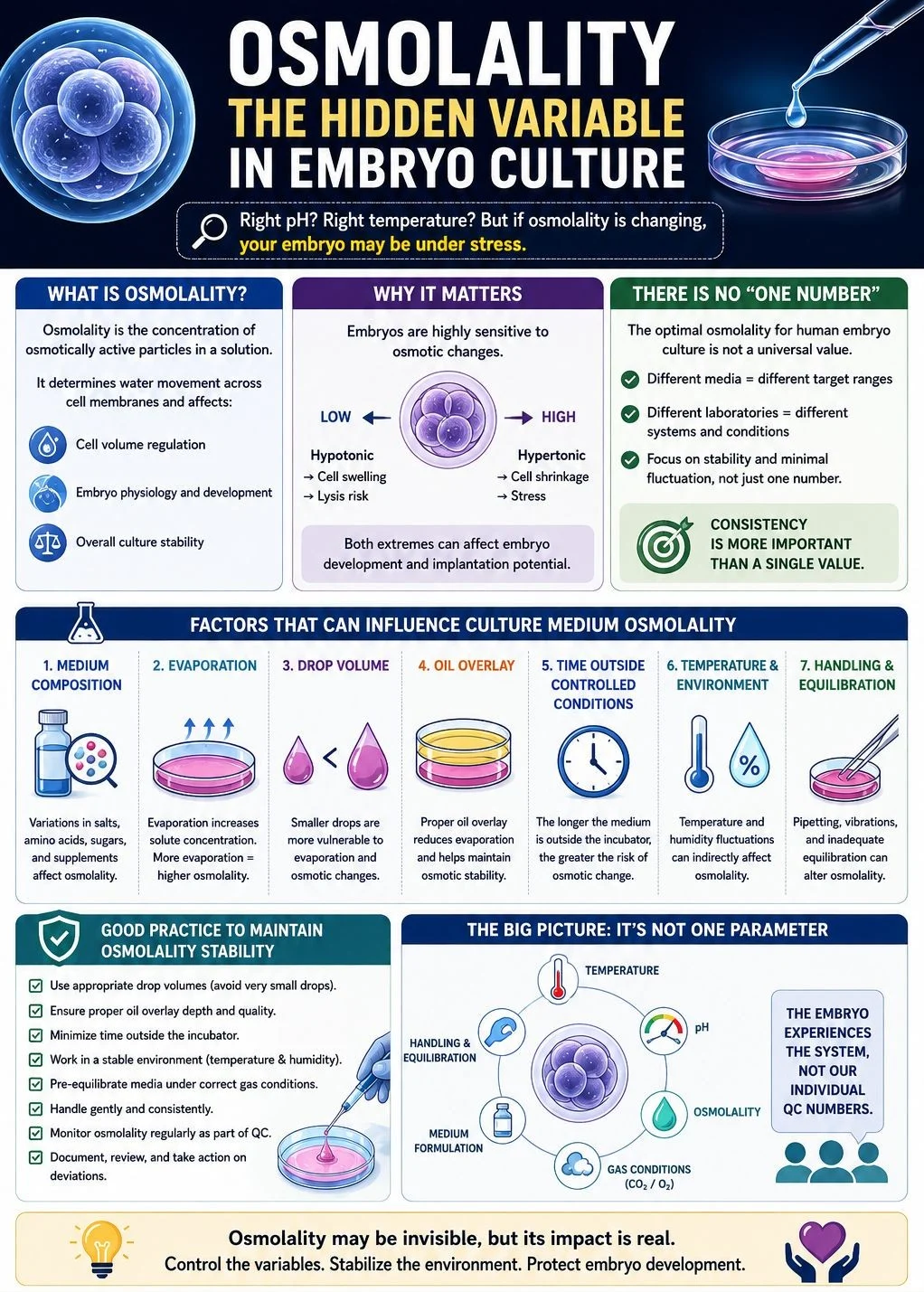
”What if your IVF culture medium has the ‘right’ pH and temperature but the osmolality is quietly changing?
We often focus on the variables we can see on the incubator:
- Temperature
- CO₂
- pH
But another physicochemical parameter deserves equal attention:
Osmolality.
Osmolality describes the concentration of osmotically active particles in the culture environment.
For an embryo, this is not simply a laboratory number.
The osmotic environment influences water movement across cell membranes and therefore contributes to cellular volume regulation and embryo physiology.
And here is where IVF laboratory practice becomes particularly important.
Culture-medium osmolality can be influenced by factors such as:
- Medium composition
- Evaporation
- Drop volume
- Oil overlay
- Time outside controlled conditions
- Temperature and environmental stability
- Handling and equilibration
Even the physical design of the culture system can matter.
Smaller culture volumes can be more susceptible to changes in osmolality, while appropriate oil overlay and controlled environmental conditions can help reduce fluctuations. Importantly, the optimal osmolality for human embryo culture is not defined by a single universal number; culture systems and media formulations differ.
This leads to an important laboratory principle:
Do not evaluate culture conditions one parameter at a time.
A medium with an acceptable pH may still be experiencing changes in other physicochemical variables.
So when we talk about embryo culture quality, perhaps the better question is not:
Is our pH correct? but:
Is the entire physicochemical environment stable?
- Temperature
- pH
- Osmolality
- Gas conditions
- Medium formulation
- Handling
- Equilibration
The embryo experiences the system, not our individual QC numbers.
That is why understanding osmolality is not just theoretical chemistry.
It is part of good embryology.
For IVF laboratory professionals:
How often do you think osmolality is underestimated when troubleshooting embryo – culture conditions?”
Stay informed with the latest updates in fertility and reproductive medicine on Fertility News.
-
Oct 16, 2026, 19:56Dina Ibrahem: Poor ICM vs. Poor TE
-
Oct 16, 2026, 19:47Sean Lauber: NIPT and Amniocentesis after PGT-A Reveal Few Abnormalities
-
Oct 16, 2026, 19:42Devyanshi Dixit: C-Section vs. Vaginal Birth – 2 Birth Paths, 2 Very Different Recoveries
-
Oct 16, 2026, 19:32Pawel Kordowitzki: Maternal Vitamin D Homeostasis, Pregnancy Outcomes and Offspring Health
-
Oct 16, 2026, 19:13Shizuko Takahashi: Our Study on Women’s Experiences of Assisted Reproductive Care in China Has Been Accepted by RBMO
-
Oct 16, 2026, 19:09ESHRE Announces ECRES-GESEA Reproductive Surgery Training and Certification in Slovenia
-
Oct 16, 2026, 18:20Kabita KB: What Happens if PLCZ1 Is Defective?
-
Oct 16, 2026, 18:12Partha Sarathi Das: From Reproductive Lifespan to Reproductive Healthspan
-
Oct 16, 2026, 18:05Joyce Harper: It Was a Pleasure to Give 2 Talks Celebrating World Menopause Day