

Partha Sarathi Das: From Reproductive Lifespan to Reproductive Healthspan
Partha Sarathi Das, Medical Director and Consultant in Reproductive Endocrinology and Infertility at Orchid Fertility, shared on LinkedIn:
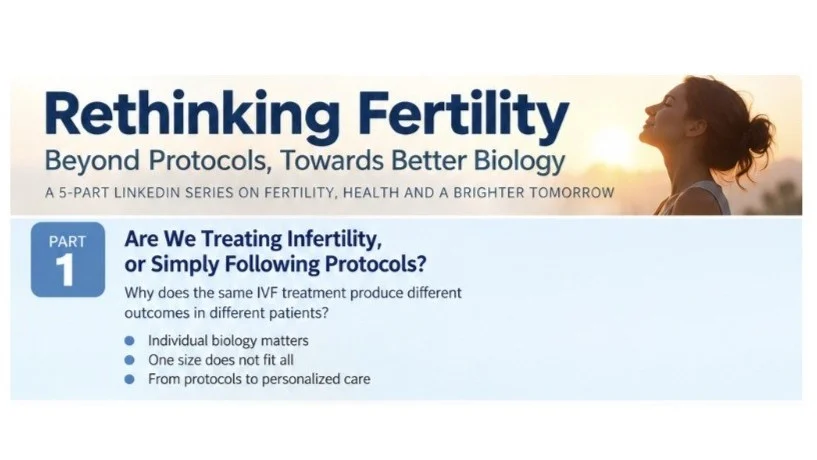
” ‘From Reproductive Lifespan to Reproductive Healthspan: Rethinking Fertility Beyond Protocols.’
I would introduce the idea of reproductive healthspan.
Healthspan describes the period of life spent in good health.
Reproductive healthspan could be a broader educational concept that encompasses reproductive development, endocrine and metabolic well-being, fertility awareness, reproductive autonomy, and healthy aging.
The future of fertility medicine begins with asking better questions.
For decades, reproductive medicine has followed established physiological principles, standardized stimulation protocols, and treatment algorithms. These have undoubtedly transformed fertility care and helped millions become parents.
But as our understanding of reproductive biology evolves, so must our willingness to question what we think we know.
If reproductive physiology follows the same fundamental principles, why do two seemingly similar patients respond so differently to the same treatment?
Why does one woman produce several competent oocytes while another, of similar age and ovarian reserve, produces very few?
Why does one embryo implant successfully while another apparently comparable embryo fails?
Why do some couples conceive naturally despite significant reproductive challenges, while others struggle despite reassuring investigations? These are not merely clinical frustrations.
They are scientific questions that deserve deeper exploration.
Shared physiology does not mean identical reproductive potential.
Age, ovarian sensitivity, egg and sperm competence, and laboratory factors can influence outcomes.
Three distinctions matter:
Ovarian reserve is not egg quality. AMH and antral follicle count help predict egg yield, but do not reliably predict an egg’s ability to result in a live birth.
A good ovarian response does not guarantee success. Egg maturity, fertilization, embryo development, implantation, and live birth are separate stages.
Individualization must be evidence-based. More medication, additional testing, or a newer technique does not automatically mean better care. Some personalized approaches improve safety, while their live-birth benefit remains uncertain.
An unexpected success after changing treatment should spark curiosity-not prove the change caused it.
Equally, an unsuccessful cycle does not automatically mean the protocol was wrong.
The future of fertility medicine is not about abandoning protocols.
It is about applying them intelligently, understanding their limitations, identifying who benefits from a different approach, and, of course, not exploiting couples’ desperation and vulnerability.
One size does not fit all-but every claim of superiority should be supported by evidence.
It’s the era of AI, and we still haven’t deciphered what ignites the spark of life. Eggs, sperm, embryo quality, euploidy status, endometrial factors, and general inflammation, etc., all play a role.
Life blooms when the body’s cellular functions are in sync. What dictates the synchronization?
Have you encountered patients with similar reproductive parameters but remarkably different treatment outcomes?”
Stay informed with the latest updates in fertility and reproductive medicine on Fertility News.
-
Oct 16, 2026, 19:56Dina Ibrahem: Poor ICM vs. Poor TE
-
Oct 16, 2026, 19:47Sean Lauber: NIPT and Amniocentesis after PGT-A Reveal Few Abnormalities
-
Oct 16, 2026, 19:42Devyanshi Dixit: C-Section vs. Vaginal Birth – 2 Birth Paths, 2 Very Different Recoveries
-
Oct 16, 2026, 19:32Pawel Kordowitzki: Maternal Vitamin D Homeostasis, Pregnancy Outcomes and Offspring Health
-
Oct 16, 2026, 19:13Shizuko Takahashi: Our Study on Women’s Experiences of Assisted Reproductive Care in China Has Been Accepted by RBMO
-
Oct 16, 2026, 19:09ESHRE Announces ECRES-GESEA Reproductive Surgery Training and Certification in Slovenia
-
Oct 16, 2026, 18:20Kabita KB: What Happens if PLCZ1 Is Defective?
-
Oct 16, 2026, 18:05Joyce Harper: It Was a Pleasure to Give 2 Talks Celebrating World Menopause Day
-
Oct 16, 2026, 18:01Somil Singhal: The Last Crucial Step in the IVF Journey