

Somil Singhal: The Last Crucial Step in the IVF Journey
Somil Singhal, Medical Doctor at AIIMS (All India Institute of Medical Sciences, New Delhi), shared on LinkedIn:
”Embryo Transfers
Embryo transfers are an excellent option for intended parents who have:
Fallopian tube damage or blockage. If fallopian tubes are damaged or blocked, the egg will struggle to become fertilized and travel to the uterus.
Ovulation disorders. Irregular or absent menstrual cycles mean fewer eggs are available for fertilization, increasing the difficulty of getting pregnant naturally.
Endometriosis. Occurring when uterine tissue implants and grows outside of a woman’s uterus, this affects the function of ovaries, uterus, and fallopian tubes.
Uterine fibroids. These are benign tumors on the uterus wall that can interfere with the embryo implantation needed for a successful conception.
Tubal ligation. If fallopian tubes were cut or removed permanently IVF and an embryo transfer can allow to conceive successfully.
Poor sperm motility or morphology. Male factor infertility is common, causing infertility in couples. Undergoing ICSI to fertilize the egg can achieve a successful embryo for implantation.
Types of Embryo Transfers
To retrieve and fertilize the intended eggs with sperm there is a option of picking these:
Frozen Embryo Transfers (FETs)
Fresh Embryo Transfers (ETs)
Day 3 Embryo Transfer
Day 5 Embryo Transfer
Multiple vs. Single Embryo Transfer
Frozen Embryo Transfers (FETs)
Most commonly performed kind of transfer, because they allow for genetic testing of embryos before implantation, which creates higher success rates and less chance of genetic defect or miscarriage.
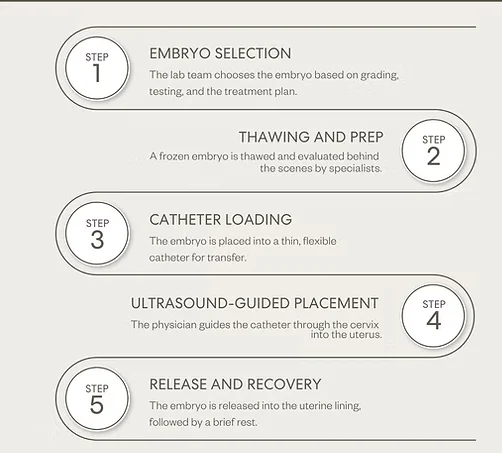
It requires a transfer catheter during a frozen embryo transfer to place the thawed embryos into your uterus. A frozen embryo transfer is a simple procedure and often doesn’t require pain relief
Fresh Embryo Transfers (ETs)
Once the intended mother’s eggs have been retrieved and fertilized it is necessary to determine which embryos have the best chance of implantation. Three to five days after the initial retrieval transfer the newly created embryos back into the intended mother or surrogate’s uterus.
Day 3 Embryo Transfer
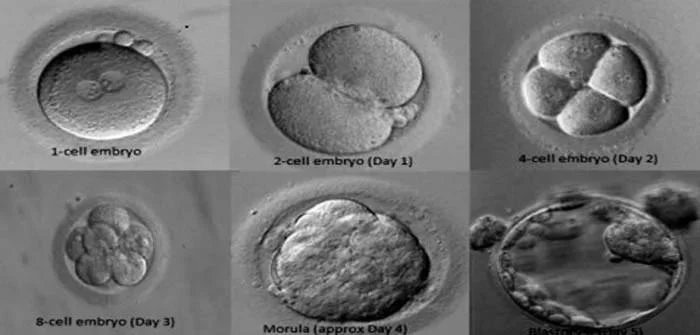
Also known as a Cleavage embryo, these embryos are named after the cells in the embryo, which are cleaving or dividing.
Day 5 Embryo Transfer
Also called a Blastocyst, the day five embryo has developed into a sphere of 60 to 120 cells surrounding a fluid-filled cavity. Blastocysts typically form on day five but can happen beyond then.
Blastocysts are often considered a better option than an earlier stage embryo because they have a higher chance of being genetically normal, implanting and leading to a successful pregnancy compared to Day 3 embryo transfers.
By prolonging the time the embryo can better elect t with the best chance of implantation and successful pregnancy.
Proper oocyte maturation is essential for subsequent fertilization and early embryonic development, which is necessary for successful reproduction.
Maturation of oocytes requires two meiosis. During meiosis, bipolar meiotic spindles form and homologous chromosomes are arranged through microtubule-organizing centers
After the spindle is assembled, with the extrusion of the first polar body, the oocyte extrudes half of its genetic material and then goes directly into the metaphase II (MII)
The oocyte arrests at MII until fertilization.
Multiple vs. Single Embryo Transfer
Factors that determine how many embryos to transfer include the embryo recipient’s age and her reproductive history.
Transferring multiple embryos can result in more live births, but it does increase the chances of medical complications for both the intended mother and the baby
Intended parents have high success rates when performing preimplantation genetic testing and diagnosis (PGS/PGT-A/PGD).
These tests allow to analyze and evaluate which embryo have the highest chance of implantation and a healthy conception.
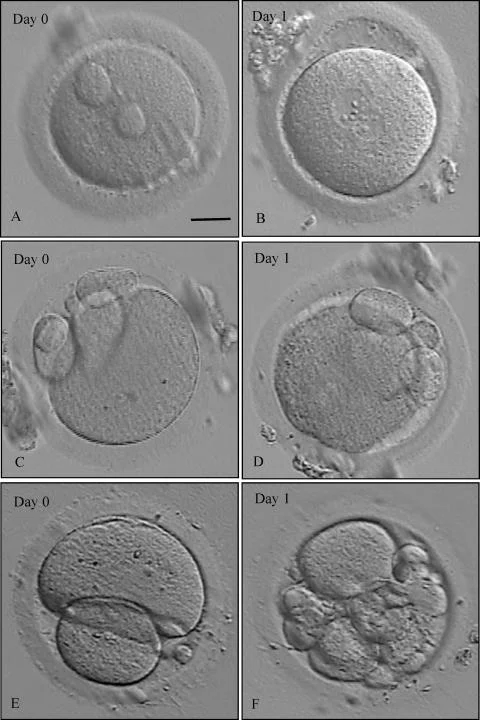
Oocyte retrieval
- Morphology of a normal mature PB2 oocyte.
- The morphology of a normal fertilized oocyte with two pronuclei (2PN).
- The morphology of an abnormal mature oocyte with multiple large-polar bodies.
- The morphology of an abnormal fertilized oocyte with one pronuclei (1PN).
- The morphology of an abnormal mature oocyte with a large-polar body.
- The morphology of an oocyte that has undergone cleavage 18 h after fertilization
Embryo Transfer Steps
Embryo Stages
 ”
”
Proceed to the video attached to the post.
Other articles featuring Somil Singhal on Fertility News.
-
Oct 16, 2026, 19:56Dina Ibrahem: Poor ICM vs. Poor TE
-
Oct 16, 2026, 19:47Sean Lauber: NIPT and Amniocentesis after PGT-A Reveal Few Abnormalities
-
Oct 16, 2026, 19:42Devyanshi Dixit: C-Section vs. Vaginal Birth – 2 Birth Paths, 2 Very Different Recoveries
-
Oct 16, 2026, 19:32Pawel Kordowitzki: Maternal Vitamin D Homeostasis, Pregnancy Outcomes and Offspring Health
-
Oct 16, 2026, 19:13Shizuko Takahashi: Our Study on Women’s Experiences of Assisted Reproductive Care in China Has Been Accepted by RBMO
-
Oct 16, 2026, 19:09ESHRE Announces ECRES-GESEA Reproductive Surgery Training and Certification in Slovenia
-
Oct 16, 2026, 18:20Kabita KB: What Happens if PLCZ1 Is Defective?
-
Oct 16, 2026, 18:12Partha Sarathi Das: From Reproductive Lifespan to Reproductive Healthspan
-
Oct 16, 2026, 18:05Joyce Harper: It Was a Pleasure to Give 2 Talks Celebrating World Menopause Day