

How the Stair-Step Protocol Can Save Time in Fertility Treatment – Fertility Plus
Fertility Plus shared a post on LinkedIn:
“Tried Clomid and it didn’t work?
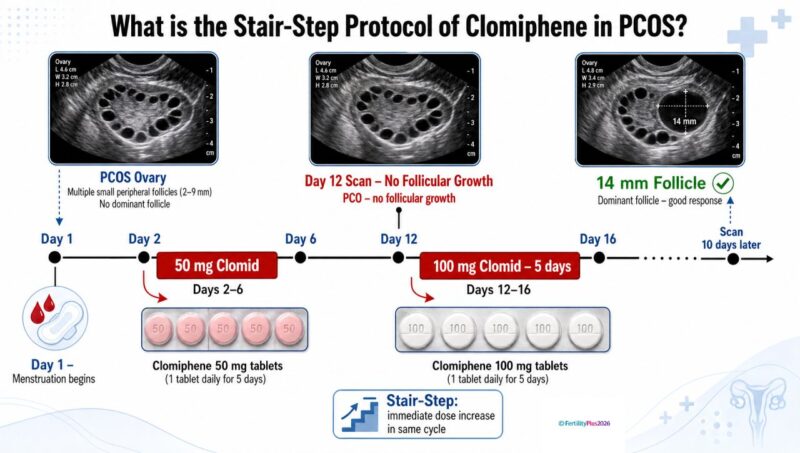
There’s a smarter way many fertility doctors use for PCOS patients called the Stair-Step Protocol.
Here’s the simple version:
Start with 50 mg Clomid (Days 2–6) → Day 12 scan shows no follicle? → Immediately step up to 100 mg for 5 days in the same cycle.
Many women who had zero response at 50 mg suddenly grow a healthy 14 mm follicle after the higher dose — without wasting a whole month waiting for the next cycle. This is the power of the stair-step method.
Have you tried Clomid before? Did it work or did you need to step up? Drop your experience below
(For educational purposes only — always discuss with your fertility specialist.)”
Ting Yuan, Co-Founder and Clinical Director at Zhaoxi Fertility Center Malaysia, shared Fertility Plus’s post, adding:
“Clomiphene and stair-step protocols are valuable tools for women with ovulatory dysfunction, particularly those with PCOS who experience delayed or absent ovulation. one of their greatest advantages is helping patients reach ovulation more efficiently and identify the fertile window for timed intercourse.
However, ovulation does not necessarily equal pregnancy. in clinical practice, I often see women who successfully ovulate after Clomiphene, have appropriately timed intercourse, and yet still struggle to conceive naturally.
One possible explanation is that follicular growth and ovulation are not the same as oocyte quality.
Medications can help follicles grow to a mature size, but ultrasound can only show us the size of the follicle ,it cannot tell us the quality of the egg inside.
The same principle applies to IUI.creating an ovulation opportunity is important, but successful conception ultimately depends on much more than follicle size alone.this may partly explain why some patients ovulate successfully, yet pregnancy still does not occur.
In fertility care, finding ovulation is often only the beginning of the journey.”
Stay updated on all scientific advances in the field of fertility with Fertility News.
-
Sep 13, 2026, 15:11Sachintha Alwis: From Impaired Sperm Motility to Microrobotics
-
Sep 13, 2026, 15:08Laurence Orbuch: Before Endometriosis Surgery, Ask…
-
Sep 13, 2026, 15:05Ademola Ayodele: IUI, IVF or Egg Freezing – Which One Is Right for You?
-
Sep 13, 2026, 14:59Fiona Pathiraja-Møller: Tennis Players No Longer Have to Choose Between Career and Family
-
Sep 13, 2026, 14:571-Day Virtual Experience for People Impacted by PMOS – PCOS Awareness Association
-
Sep 13, 2026, 14:53Ozor Victor: Behind Every Embryo Is a Story of Science, Precision, and Hope
-
Sep 13, 2026, 14:50Diana Kayal: What They Don’t Tell You About IVF
-
Sep 13, 2026, 14:44Vikram Sinai Talaulikar: A Heartfelt Thank You to All Who Donated and Supported “Menopause and Cancer”
-
Sep 13, 2026, 14:41Nicole McPherson: Changing IVF Practices Is Hard – Integration Needs to Be Easy