
Applying PAS Surgical Principles to Complex Caesarean Delivery – GEFOG Health Foundation
GEFOG Health Foundation shared a post on LinkedIn:
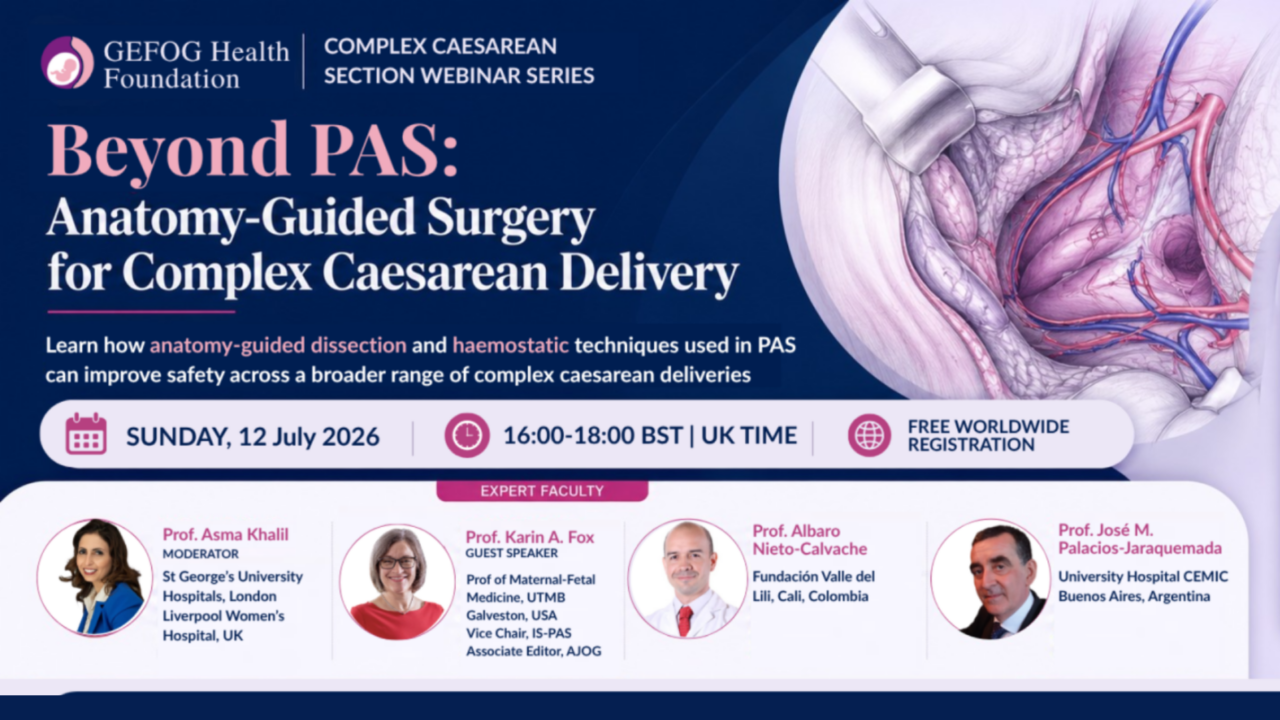
“Are we limiting our best surgical principles to only the rarest cases?
The meticulous anatomy-guided dissection and topography-guided haemostasis techniques developed for Placenta Accreta Spectrum (PAS) shouldn’t stay locked inside PAS surgeries.
Difficult exposure, severe adhesions, and distorted pelvic anatomy happen in thousands of non-PAS complex caesarean deliveries every single day. Operating safely begins with optimal exposure, meticulous dissection, and anatomy-guided haemostasis – frameworks shared across all levels of surgical complexity.
Join the GEFOG Health Foundation for our upcoming webinar: ‘Beyond Placenta Accreta Spectrum: Applying Anatomy-Guided Surgical Principles to Complex Caesarean Delivery’.
Prof. Karin A. Fox, Prof. Albaro Nieto-Calvache and Prof. José M. Palacios-Jaraquemada will lead an interactive clinical case discussion demonstrating how PAS surgical dissection concepts can be applied directly to routine, challenging caesarean sections.
Date: Sunday, 12 July 2026
Time: 16:00–18:00 BST | UK time
Format: Online webinar | Free worldwide
Expert Faculty:
Prof Asma Khalil (Moderator) – Lead Consultant for Multiple Pregnancy Services at St George’s University Hospitals, London, UK.
Prof. Karin Fox (Guest Speaker) – Professor of Maternal-Fetal Medicine, UTMB Galveston; Vice Chair of the International Society for PAS. USA
Prof. Albaro Jose Nieto Calvache – Specialist in Complex Obstetric Surgery and PAS, Fundación Valle del Lili, Colombia.
Prof. José M. Palacios-Jaraquemada – Obstetric Surgeon, Fellow of RCOG, FIGO Working Group on Labour and Delivery, Argentina.
What You Will Learn:
- Why complex caesarean delivery must be recognised as a broader surgical entity beyond PAS.
- Safe bladder dissection and identifying appropriate surgical planes.
- How to apply anatomy-guided and topography-guided haemostasis under pressure.
- Managing complex non-PAS cases to support progressive surgical training.
Additional Benefits:
Certificate of attendance for live participants.
Access to the recording for all registered attendees.
Direct access to global thought leaders during the live QaA.
Who Should Attend?
Obstetricians, Gynaecologists, Maternal-Fetal Medicine Specialists, Obstetric Surgeons, PAS and High-Risk Obstetric Teams, Trainees, Fellows, Anaesthetists, and Critical Care Professionals.
Secure your spot now by clicking ‘Attend’ on this event page or registering directly here.”
Stay updated on all scientific advances in the field of fertility with Fertility News.
-
Oct 16, 2026, 19:56Dina Ibrahem: Poor ICM vs. Poor TE
-
Oct 16, 2026, 19:47Sean Lauber: NIPT and Amniocentesis after PGT-A Reveal Few Abnormalities
-
Oct 16, 2026, 19:42Devyanshi Dixit: C-Section vs. Vaginal Birth – 2 Birth Paths, 2 Very Different Recoveries
-
Oct 16, 2026, 19:32Pawel Kordowitzki: Maternal Vitamin D Homeostasis, Pregnancy Outcomes and Offspring Health
-
Oct 16, 2026, 19:13Shizuko Takahashi: Our Study on Women’s Experiences of Assisted Reproductive Care in China Has Been Accepted by RBMO
-
Oct 16, 2026, 19:09ESHRE Announces ECRES-GESEA Reproductive Surgery Training and Certification in Slovenia
-
Oct 16, 2026, 18:20Kabita KB: What Happens if PLCZ1 Is Defective?
-
Oct 16, 2026, 18:12Partha Sarathi Das: From Reproductive Lifespan to Reproductive Healthspan
-
Oct 16, 2026, 18:05Joyce Harper: It Was a Pleasure to Give 2 Talks Celebrating World Menopause Day