

Christina Walker: The Questions We Ask Today Will Shape the Future of Women’s Health
Christina Walker, Program Director at CLS Event and Publication, shared on LinkedIn:
“The Questions We Ask Today Will Shape the Future of Women’s Health.
Join the Conversation at GFWH 2026
The 12th Global Summit on Gynecology, Fertility and Women’s Health (GFWH 2026) will bring together professionals and researchers to exchange ideas, discuss emerging science, and explore innovations shaping the future of women’s healthcare.
- Time: November 23–24, 2026
- Location: Bangkok, Thailand
- Grand Mercure Bangkok Atrium
What Are the Biggest Unsolved Challenges in Women’s Health?
Women’s health has made remarkable progress over the past several decades. Advances in gynecology, reproductive medicine, maternal care, cancer screening, genetics, and digital health have transformed diagnosis and treatment.
Yet many important questions remain unanswered.
Across the world, millions of women continue to experience delayed diagnoses, limited access to specialized care, inadequate representation in research, and health conditions that remain poorly understood. The next era of women’s healthcare will require more than technological innovation – it will require better research, earlier intervention, personalized medicine, and stronger collaboration across disciplines.
So, what are the biggest unsolved challenges in women’s health today?
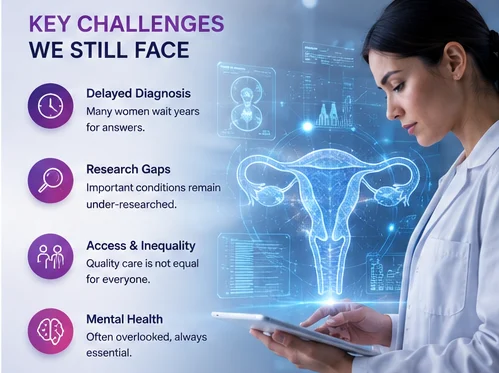
1. Delayed Diagnosis of Women-Specific Conditions
Conditions such as endometriosis, polycystic ovary syndrome (PCOS), adenomyosis, and certain reproductive disorders can take years to diagnose.
Symptoms may overlap with other conditions, vary significantly between individuals, or be normalized as a routine part of women’s lives.
Earlier recognition could potentially improve treatment pathways, reduce complications, and improve quality of life.
The challenge is developing better diagnostic tools, biomarkers, clinical pathways, and awareness strategies that allow healthcare professionals to identify these conditions earlier.
2. Closing the Women’s Health Research Gap
Despite major advances in medical science, important gaps remain in our understanding of many conditions that disproportionately or exclusively affect women.
Research needs to continue exploring how biological sex, hormonal changes, reproductive stages, genetics, lifestyle, environment, and social factors influence disease.
A stronger evidence base can help clinicians move from generalized treatment approaches toward more precise and individualized healthcare.
3. Personalized Fertility Care
Fertility is highly individual, yet predicting reproductive outcomes remains complex.
Age, ovarian reserve, genetics, metabolic health, lifestyle, reproductive history, sperm factors, and other variables can influence fertility.
Advances in artificial intelligence, reproductive genetics, embryo assessment, biomarkers, and data-driven medicine may offer new opportunities for personalized fertility care.
However, an important challenge remains: determining which emerging technologies provide meaningful clinical value while maintaining ethical, transparent, and patient-centered care.
4. Understanding Endometriosis and Chronic Pelvic Pain
Endometriosis affects millions of women worldwide, but diagnosis can be challenging and symptoms can be diverse.
Many women experience chronic pelvic pain, painful menstruation, infertility, fatigue, or other symptoms before receiving an accurate diagnosis.
Research is continuing to investigate improved biomarkers, imaging approaches, non-invasive diagnostics, and more effective treatment strategies.
The long-term goal is clear: faster diagnosis and more effective, individualized management.
5. PCOS: More Than a Reproductive Disorder
PCOS is often discussed in relation to irregular periods, infertility, and androgen-related symptoms. However, its relationship with metabolic and long-term health makes it a much broader healthcare challenge.
Research continues to explore the complex interaction between reproductive, metabolic, hormonal, genetic, and lifestyle factors.
A major opportunity lies in moving toward lifelong, individualized PCOS management rather than focusing only on immediate reproductive symptoms.
6. Maternal Health and Pregnancy Complications
Pregnancy should be supported by safe, evidence-based care, yet maternal health challenges remain significant in many parts of the world.
Conditions including hypertensive disorders of pregnancy, gestational diabetes, hemorrhage, preterm birth, and other complications require continued research and early intervention.
Improving maternal health will require stronger prevention strategies, better risk prediction, access to quality care, and coordinated support before, during, and after pregnancy.
7. Menopause and Healthy Aging
Menopause is a major biological transition, but healthcare systems have not always treated it as an important component of long-term women’s health.
Women may experience vasomotor symptoms, sleep changes, mood changes, sexual health concerns, bone health issues, and metabolic changes.
The challenge is developing individualized approaches that recognize the diversity of women’s experiences and integrate menopause care into broader healthy-aging strategies.
8. The Role of Lifestyle and Environmental Factors
Nutrition, physical activity, sleep, stress, metabolic health, environmental exposures, and other lifestyle factors can interact with reproductive and overall health.
However, translating growing research into practical, evidence-based recommendations remains challenging.
Future research needs to distinguish between broad health advice and interventions that can be demonstrated to meaningfully improve specific outcomes.
9. Artificial Intelligence: Opportunity and Responsibility
Artificial intelligence is rapidly entering healthcare, including imaging, risk prediction, clinical decision support, fertility care, and research.
AI could help clinicians identify patterns that are difficult to detect manually and potentially support earlier diagnosis and personalized treatment.
But technology alone is not the solution.
Important questions remain around data quality, bias, privacy, transparency, clinical validation, accessibility, and human oversight.
The goal should not be AI replacing healthcare professionals. It should be technology helping clinicians make better-informed decisions while keeping patients at the center of care.
10. Mental Health as an Integral Part of Women’s Health
Women’s physical and reproductive health cannot be separated from mental and emotional wellbeing.
Infertility, pregnancy, postpartum changes, chronic gynecological conditions, menopause, cancer, and other health experiences can have significant psychological effects.
Healthcare models that integrate mental health support with physical and reproductive care could provide a more complete approach to women’s wellbeing.
11. Inequality in Access to Women’s Healthcare
Scientific progress does not automatically translate into equal access.
Differences in geography, socioeconomic conditions, healthcare infrastructure, education, and availability of specialists can influence whether women receive timely diagnosis and treatment.
The future of women’s health must therefore focus not only on what is scientifically possible, but also on who can access it.
12. Turning Research Into Real-World Care
One of the biggest challenges is the gap between scientific discovery and clinical implementation.
A promising laboratory finding may take years to become a validated diagnostic tool or treatment.
Bridging this gap requires collaboration between researchers, clinicians, technology developers, healthcare institutions, policymakers, and patients.
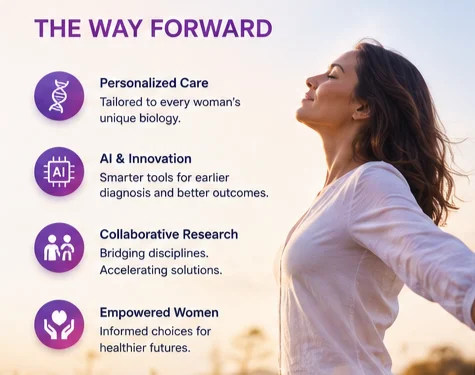
What Will Solve These Challenges?
There is unlikely to be one single solution.
The future of women’s health will depend on combining:
- Precision medicine
- Earlier diagnosis
- Artificial intelligence and digital health
- Reproductive genetics
- Advanced imaging and diagnostics
- Preventive healthcare
- Patient-centered care
- Multidisciplinary research
- Global scientific collaboration
- Better representation in research
Most importantly, women need to be active participants in the development of the healthcare solutions designed for them.
Looking Ahead
The biggest unanswered questions in women’s health are also some of the greatest opportunities for scientific discovery.
- Can we diagnose endometriosis earlier?
- Can fertility care become more personalized?
- Can AI improve clinical decision-making without introducing new inequalities?
- Can we better predict pregnancy complications?
- Can menopause care become a more integrated part of healthy aging?
- Can research move faster from discovery to real-world impact?
These challenges require researchers and healthcare professionals to look beyond individual specialties.
The future of women’s health will be shaped by collaboration-bringing together gynecologists, fertility specialists, reproductive endocrinologists, geneticists, embryologists, researchers, data scientists, technology innovators, and patients.
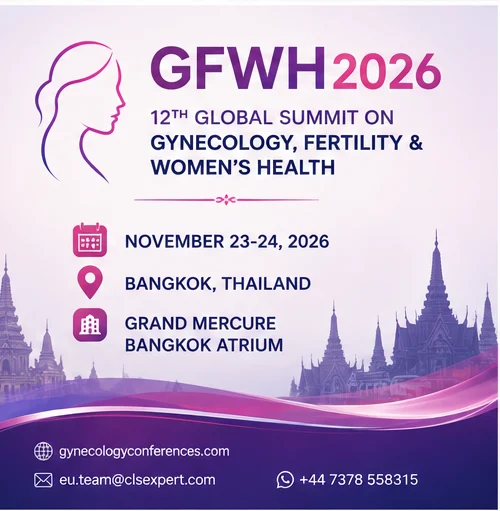
Join the Conversation at GFWH2026
The 12th Global Summit on Gynecology, Fertility and Women’s Health (GFWH2026) will bring together professionals and researchers to exchange ideas, discuss emerging science, and explore innovations shaping the future of women’s healthcare.
- Time: November 23–24, 2026
- Location: Bangkok, Thailand
- Grand Mercure Bangkok Atrium
- Theme: Next-Gen Women’s Health: Innovation, Fertility Breakthroughs & Precision Gynecology
Other articles on GFWH 2026 on Fertility News.
-
Oct 16, 2026, 19:56Dina Ibrahem: Poor ICM vs. Poor TE
-
Oct 16, 2026, 19:47Sean Lauber: NIPT and Amniocentesis after PGT-A Reveal Few Abnormalities
-
Oct 16, 2026, 19:42Devyanshi Dixit: C-Section vs. Vaginal Birth – 2 Birth Paths, 2 Very Different Recoveries
-
Oct 16, 2026, 19:32Pawel Kordowitzki: Maternal Vitamin D Homeostasis, Pregnancy Outcomes and Offspring Health
-
Oct 16, 2026, 19:13Shizuko Takahashi: Our Study on Women’s Experiences of Assisted Reproductive Care in China Has Been Accepted by RBMO
-
Oct 16, 2026, 19:09ESHRE Announces ECRES-GESEA Reproductive Surgery Training and Certification in Slovenia
-
Oct 16, 2026, 18:20Kabita KB: What Happens if PLCZ1 Is Defective?
-
Oct 16, 2026, 18:12Partha Sarathi Das: From Reproductive Lifespan to Reproductive Healthspan
-
Oct 16, 2026, 18:05Joyce Harper: It Was a Pleasure to Give 2 Talks Celebrating World Menopause Day