
What Intended Parents Wish Their Clinics Explained Earlier About Donor Egg IVF – Fairfax EggBank
Fairfax EggBank shared on LinkedIn:
” ‘Why didn’t anyone tell me this sooner?’
It’s a question no fertility professional wants to hear from an intended parent. And yet, even with the best clinical care, it happens.
A success rate that meant something different than a patient fully understood. A donor screening result that raised new questions. A financial commitment that turned out to be more complicated than expected.
At Fairfax EggBank, we believe the best time to build patient trust is before patients know they need reassurance.
So we asked our clinical, laboratory, and counseling experts to identify five conversations that deserve to happen earlier in the journey, and we can make those conversations clearer, more meaningful, and more actionable.
The result is a practical resource for clinic teams, including eight questions every intended parent should feel empowered to ask (and we should be prepared to answer). Informed consent shouldn’t just be a form patients sign. It should be a conversation they understand.
For our clinical partners: Which conversations do you wish more patients had before beginning treatment?
Read the full article.
What Intended Parents Wish Their Clinics Explained Earlier About Donor Egg IVF
Fertility professionals hear this from intended parents all the time, but sometimes the answer is more complicated than it needs to be:
‘Why didn’t I know this before?’
It can come after an intended parent learns that a 90% egg survival rate does not mean a 90% chance of pregnancy.
It can come after a cohort yields fewer embryos than they’d imagined six or eight eggs might produce in the end.
And sometimes it happens much later, when a parent realizes that choosing an ID Option or Non-ID Option donor carried implications they didn’t fully appreciate or truly understand when they were perusing donor profiles.
But here’s the thing. None of these concepts are impossible to explain. They are actually all pretty simple. It’s just that clear communication and timing matter. Information delivered after a decision becomes an explanation, which, in a high-stakes situation field like reproductive medicine, is simply not acceptable. Delivered before, however, it becomes informed consent, which is exactly what we live by here at Fairfax EggBank.
That’s why we asked our clinical, laboratory, and mental health consulting experts to consider the most important conversations intended parents benefit from having with their teams earlier, and what fertility professionals can do to make everything as clear as possible as soon as possible.
TL;DR
Five concepts deserve to be explained with painstaking clarity right at the beginning of a donor egg process.
- What ‘success rates’ actually measure
- How eggs move through the egg-to-embryo attrition funnel
- What donor screening and update protocols can and cannot tell us
- What ID and disclosure decisions may mean for a future child, and
- What the full timeline, costs, and guarantees actually include
For intended parents, understanding these five concepts can make this often-overwhelming process more navigable. For clinic teams, explaining them early can prevent an information gap from becoming a trust gap.
1. ‘Success’ is not a single number (and often not as straightforward as it sounds)
Understandably, intended parents want to know their odds from the outset. What are the chances this will work?
The challenge is that fertility care can answer that question with a lot of technically accurate numbers that measure and answer for very different things. So, we have to be clear, both on what is being asked and what is being answered.
For example, an egg bank might report post-warm survival. A laboratory may discuss fertilization or blastocyst development. A clinic might quote pregnancies or live births per embryo transfer.
On the receiving end, meanwhile, intended parents could potentially hear every one of those numbers and think of them as answers to a less nuanced question (arguably, the only one that really matters to them): What is my chance of taking home a baby?
That distinction matters.
National SART reporting illustrates the issue. Its donor-egg data separates
- Fresh donor eggs
- Frozen donor eggs
- Thawed embryos created from donor eggs, and
- Donated embryos
and reports outcomes using defined denominators such as recipient starts/thaws and transfers. In SART’s 2024 national data, for example, frozen donor eggs had a reported live-birth rate of 39.1% per recipient start/thaw. That statistic is useful, but it is not an egg survival rate, blastocyst rate, or an individual patient’s cumulative probability of live birth from everything generated by a purchased cohort. There is never a one-size-fits all answer that can be passed around that covers all of that.
The same scrutiny should apply to an egg bank’s laboratory statistics.
Jennifer Hart, M.S., TS(ABB), Director of Embryology Relations at Fairfax EggBank, recommends asking what sits behind the headline number: How was it calculated? What denominator was used? How many cycles are represented? Were all warming events included? And what happens when results fall below expectations?
That is also why guarantees should be described according to the outcome they actually guarantee.
A survival guarantee, for example, protects an early laboratory checkpoint. Fairfax EggBank’s Blastocyst Guarantee instead guarantees at least one blastocyst usable for transfer, biopsy, or cryopreservation with each paid cohort, provided the guarantee’s terms are met. It does not guarantee implantation, pregnancy, or live birth.
For clinics: Transparency > flash every time. Lead with the denominator rather than the most impressive percentage. Then explain where that number sits between an egg being warmed and a baby being born. Realistic expectations are the foundation of any solid, trusting relationship, and that is what we are striving for with our intended parents.
If a patient remembers one thing from the success-rate conversation, I want it to be this: says Hart, always ask, ‘Success measured from what point, to what outcome?’ A percentage without those two pieces can be completely accurate and still tell you very little about your own journey.
2. Six eggs does not mean six embryos: Illustrating the attrition funnel
One of the most useful diagrams a donor egg patient can see at the beginning of treatment may also be one of the simplest:
Eggs → surviving eggs → fertilized eggs → blastocysts
The number naturally narrows along the way, but not every intended parent is aware of what this will look like. That’s why we literally draw it out.
Wayne Caswell, Vice President of Laboratory Services at Fairfax EggBank, recently walked intended parents through this attrition in detail. At Fairfax EggBank, approximately 90-93% of our frozen donor eggs survive warming. ~75% of surviving eggs fertilize normally, and approximately half of fertilized eggs develop into viable blastocysts. Of course, note that these figures are expectations across populations, not predictions for any single individual cohort.
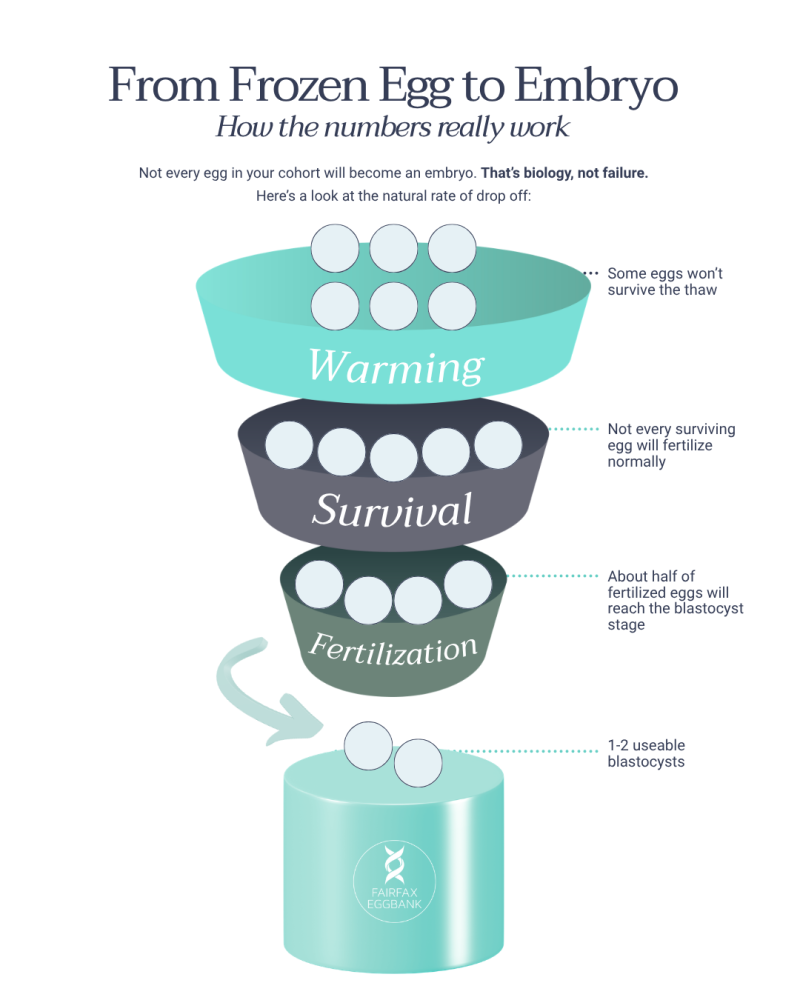
The critical message is not simply that attrition occurs. It is that attrition is a normal part of the biology of this process, and definitely not automatic evidence that something went wrong.
It is also why frozen donor eggs are generally sold in cohorts rather than individually.
As Caswell has explained, a cohort will, by design, usually absorb natural drop-off along the way and provide a realistic opportunity to reach a usable embryo. A family hoping for multiple children may therefore approach cohort planning differently from one whose goal is one child.
But biology is not the only variable. Laboratory techniques also matter.
The receiving IVF laboratory performs the warming procedure. Therefore, protocol adherence, timing, equipment, media preparation, temperature control, workstation setup, and embryologist experience can all introduce variability. That’s why Fairfax’s embryology team works directly with receiving laboratories through virtual onboarding, on-site visits, protocol support, audits, and outcomes review. We are incredibly invested in ensuring the best possible outcomes for our intended parents.
As Caswell always says, ‘the enemy of quality is uncontrolled variability.’
For clinics: Show and explain the attrition funnel during the first donor-egg consultation. Open the floor for questions. Create space for dialogue. Patients are far better positioned to interpret an outcome when they already understand what normal attrition looks like, so setting expectations and determining what success for individual intended parents looks like is a good place to start. Caswell reminds us that ‘it is also important for patients to realize if their results are not in line with the average, it is still considered a ‘normal’ outcome based on Gaussian distribution’
3. Donor screening is extensive, but it is not a promise of zero genetic risk.
The phrase ‘fully screened donor’ can inadvertently create another misunderstanding.
Egg donors undergo substantial screening. In fact, that’s one of the largest barriers in our donor recruitment: it takes 3-5 months to cycle as a donor, and the first 5-6 weeks alone are just going through the genetic screening. Then, factor in Fairfax EggBank’s standard medical and family history review, physical and fertility evaluation, FDA-required infectious disease testing, expanded genetic carrier screening, and psychological evaluation.
FDA requirements establish important communicable disease protections. It’s required that reproductive tissue donors be screened for relevant risk factors and tested for specified infectious diseases including HIV-1/2, hepatitis B, hepatitis C, syphilis, chlamydia, and gonorrhea.
Then, ASRM’s current gamete-donation guidance addresses medical evaluation, genetic risk assessment and counseling, and psychoeducational evaluation in addition to FDA donor-eligibility requirements, so when you factor in all of the major time commitments that go into the donor process, you can see why it takes a very real level of commitment and desire to help on the part of the donor to make our frozen donor egg program work the way it does.
However, no screening program can identify every possible present or even potential future health condition or eliminate genetic risk entirely.
Expanded carrier screening is particularly important to explain in context. A healthy donor may be a carrier for a recessive condition without having that condition herself. That result does not necessarily make her an unsuitable donor, but it does make genetic compatibility with the sperm source a critical part of the conversation.
On another important note, medical and family histories are inherently dynamic. Information collected during the screening of an egg donor represents what is known at that particular moment in time. After donation, a donor, donor-conceived person, or biological relative may receive a new diagnosis or genetic finding that could have implications for others who share a genetic relationship.
Rawan Isam Awwad, Director of Clinical Genetics, along with some of her colleagues nation-wide, is leading the way on calling for clearer professional guidance on how new medical information should be evaluated and communicated after a donation has already occurred.
As the field standardizes this practice, Fairfax EggBank holds the health and safety of both our families and our donors to the highest standard in this regard. Our board-certified genetic counselors, led by Awwad, support intended parents and clinical teams with genetic compatibility matching and interpretation of donor medical and genetic information before, during, and long after their donation journey.
For clinics: We can’t simply relay to patients that a donor was ‘screened.’ We explain the layers of screening, provide the available summary documentation, discuss residual risk, and give patients an opportunity to ask genetics questions before donor selection is finalized.
‘Screening is about minimizing identifiable reproductive risk as rigorously as possible, but it can never mean eliminating every possible risk. Patients deserve to understand both sides of that sentence,’ states Awwad. ‘Our goal is to support our donors, intended parents, and donor-conceived persons in making informed reproductive and health decisions, help gamete banks maintain appropriate standards for continued donation, and enable clinicians to provide relevant counseling and responsible care.’
4. Disclosure decisions belong near the beginning of the process
Choosing an egg donor can initially feel like a decision about pregnancy.
It is also a decision whose implications may extend decades into a child’s life.
At Fairfax EggBank, donors may participate as ID Option or Non-ID Option donors.
With an ID Option donor, a registered donor-conceived person may request specified identifying and contact information from Fairfax once they reach age 18. The donor does not acquire parental rights or financial obligations.
Non-ID, however, should not be interpreted to mean guaranteed anonymity forever.
Consumer DNA testing, genealogy databases, social media, and genetic relatives can make unintended identification possible even when neither the donor nor recipient independently chooses disclosure. As a result, American Society for Reproductive Medicine – ASRM has moved away from the term ‘anonymous’ to ‘non-directed’ in order to be clearer that fully guaranteed anonymity is simply not possible.
So we believe that this makes how intended parents plan to talk to their donor-conceived child about donor conception that much more important from the very beginning.
ASRM strongly encourages disclosure of donor conception to donor-conceived people, emphasizing counseling when possible, and exercising informed consent around external disclosure and information sharing. Research and counseling literature increasingly supports an ‘early and often’ approach in which donor conception becomes part of the child’s story rather than a revelation later in life.
Expert Lisa Schuman of the Center for Family Building recently spoke with us about the major difference between privacy vs. secrecy, making an important distinction: families can preserve privacy about their family-building story without keeping the child’s own conception story a secret from them.
Schuman has put it plainly: ‘Feelings of shame are typically part of secrecy, whereas everyone is entitled to their privacy.’
It’s that simple.
For clinics: Try to move disclosure counseling upstream. Introduce ID status, future contact, DNA testing, and age-appropriate disclosure before donor selection, not after pregnancy. This can be immensely helpful to intended parents in the long term, whether or not they are aware of it at the time. This is where additional mental health training for your staff may be worth the investment.
5. Patients need the whole roadmap: timeline, cost and what happens if things do not go as planned
Frozen donor eggs offer one major logistical advantage: when it comes to the way Fairfax operates, much of the uncertainty surrounding the donor’s side of the process has already happened.
- The donor has already been screened.
- Retrieval has already occurred.
- The eggs have already been vitrified.
- Available cohorts can be selected without waiting for a donor match, ovarian stimulation, retrieval, or synchronization between donor and recipient cycles.
However, that does not mean every intended parent has the same treatment timeline. Clinic onboarding, genetic review, shipping, recipient preparation, fertilization, embryo development, additional testing when elected, and transfer planning can all affect timing. And cost deserves the same level of specificity. A cohort price should not be mistaken for the total cost of a donor-egg IVF journey.
Intended parents should have full clarity on:
- Which services are being billed by the egg bank versus the fertility clinic and other providers
- Whether shipping or storage charges apply
- What medications, laboratory procedures, genetic testing, embryo biopsy or PGT, transfer, and monitoring may cost, and
- Exactly what any refund, replacement, or assurance program covers
Transparency here is not merely logistical. The financial implications of family planning can be impactful, and families deserve to know exactly what they are committing to up front in order to plan logistically, clinically, and emotionally for what comes next.
So all of that being said, we asked our team of experts exactly what they would advise any intended parent to ask their clinic before getting started. Here were their honest answers:
8 questions to ask your clinic
- When you quote a success rate, what exactly is the denominator and what outcome are you measuring?
- What are your post-warm survival, fertilization, blastocyst-development, and live-birth outcomes, and over what time period were they measured?
- How many donor eggs should we realistically consider for our personal family-building goals?
- What process do you have in place for sharing medical updates that may arise on our donor in the future?
- Is this donor ID Option or Non-ID Option, and what could that mean for our future child?
- What exactly is included in the quoted price, and which expenses should we expect separately?
- What does the guarantee cover, what conditions must be met, and what happens if the cohort does not meet that standard?
- From donor selection to embryo transfer, what steps could affect our individual timeline?
The best time for transparency is before patients know they need it.
If we’re doing this the right way, these conversations either fall off the radar as the timeline moves on and they become unneeded, or they become part of a critical recall mechanism.
Explaining it early makes it easier to navigate when the situation requires it.
For clinic teams, that can translate into a simple five-point communication protocol:
- Define success-rate denominators
- Visualize expected attrition
- Explain screening alongside residual risk
- Introduce disclosure and ID considerations before donor selection, and
- Provide one integrated roadmap for timing, cost, and guarantees
Some of those conversations go well beyond a set of handouts or brochures. They are harder than offering a reassuring headline number. But candor is part of quality care, and if you’re reading this as a clinician, we know that’s what you’re here to provide. You know that when an egg bank and clinic function as scientific and counseling partners, our intended parents feel the difference long before their first eggs are warmed.
Frequently Asked Questions
How many frozen donor eggs do I need for a good chance at a live birth?
There is no universal number that guarantees a live birth. Eggs naturally drop out at each stage from warming through fertilization, blastocyst development, transfer, and pregnancy. Your family-building goals also matter: someone hoping for multiple children may need a different strategy than someone pursuing one child. Discuss cohort size and cumulative expectations with your clinic and egg bank.
What genetic testing is done on egg donors?
Programs vary. Fairfax EggBank donors undergo expanded genetic carrier screening in addition to medical and family history review and FDA-required infectious disease screening. Genetic screening reduces identifiable risk but cannot test for every possible genetic or future medical condition, which is why compatibility assessment and genetic counseling remain important.
Can my child contact their egg donor later?
It depends. Under Fairfax EggBank’s ID Option program, a registered donor-conceived person can request specified identifying/contact information once they reach 18. Non-ID arrangements do not provide that pathway through the bank, although consumer DNA testing means permanent anonymity cannot be guaranteed in practice.
How long does a frozen donor egg cycle take compared with a fresh cycle?
Frozen donor eggs eliminate several potentially time-consuming steps because donor screening, stimulation, retrieval, and vitrification have already occurred. Donor and recipient cycles don’t need to be synchronized. The recipient’s actual timeline still depends on their clinic, medical preparation, shipping and lab plan, embryo development, and whether additional testing is needed.”
Stay informed with the latest updates in fertility and reproductive medicine on Fertility News.
-
Nov 6, 2026, 18:05Harpreet Kehal: NIPT at 8 Weeks – Is It Ready for Practice?
-
Nov 6, 2026, 18:01Raouf Roshdy: Honored to Have Delivered My First Workshop in the Kingdom of Saudi Arabia at MEDGO 5
-
Nov 6, 2026, 17:58Dorit Kieslinger: Time-Lapse Imaging Does Not Improve Live Birth Rates
-
Nov 6, 2026, 17:52Helen O’Neill: Our Work Has Won the Prize Paper at the ASRM for the IRMSIG
-
Nov 6, 2026, 17:48Khaled Abu Ali: What Is The One 1 Thing Your IVF Software Makes Harder Than It Should Be?
-
Nov 6, 2026, 17:33Vinesh Gadhia: 4 Months at Indira IVF, 34 Years in the Industry
-
Nov 6, 2026, 17:285 Questions Europe Is Still Asking About Fertility – IVI Fertility
-
Nov 6, 2026, 17:24The Future of Fertility Is… – Middle East Fertility Society
-
Nov 6, 2026, 17:20Phoebe White: A Few Numbers More People Should Know This National Fertility Awareness Week