

Rajeev Agarwal: Most Failed IVF Transfers Are About the Embryo, Not the Uterus
Rajeev Agarwal, Director of Renew Healthcare, shared on LinkedIn:
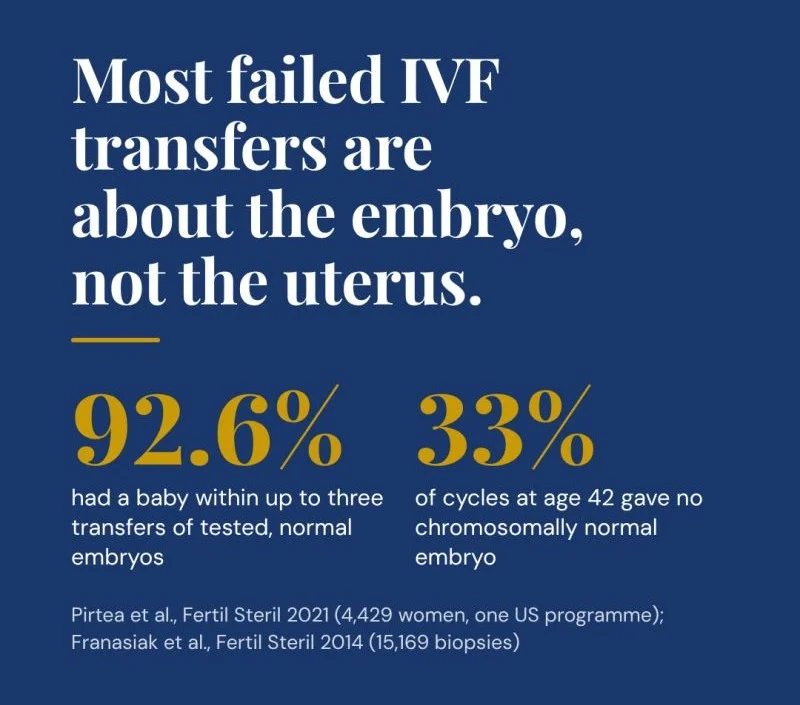
“Most failed IVF transfers are about the embryo, not the uterus.
After a failed IVF transfer, the first question couples ask me is ‘what is wrong with my uterus?’ Of all the IVF failure reasons, the embryo is the most common, and true recurrent implantation failure is rarer than many couples fear.
What the studies show. In one large US programme, among 4,429 women with a normal uterine cavity who transferred chromosomally tested (euploid) embryos one at a time, cumulative live birth after up to three transfers was 92.6%; fewer than 5% did not conceive. For untested embryos, age decides much of it: in 15,169 biopsied blastocysts, the chance of having no normal embryo at all was 2 to 6% between 26 and 37, 33% at 42 and 53% at 44. Across 156,947 UK women treated in 2003 to 2010, live birth was 29.5% after the first complete cycle, and an estimated 65.3% by the sixth for women who continued.
What the guidelines say. ESHRE (2023) defines recurrent implantation failure by probability, not by a count: the predicted cumulative chance of implantation was 60% or more, and it still has not happened. It recommends reviewing lifestyle, rechecking the lining, and testing antiphospholipid antibodies where there is a thrombosis risk. Hysteroscopy, imaging for hydrosalpinx, thyroid tests, progesterone levels, PGT-A and receptivity testing ‘can be considered’.
It recommends against intrauterine PRP, G-CSF, intralipid, IVIG, heparin and endometrial scratching for this purpose.
Where I depart. For a couple with repeated failure after good-quality embryos, when nothing else explains it, I use ERA. The largest trial, 767 women in JAMA 2022, showed no benefit (live birth 58.5% against 61.9%), but it excluded women with repeated failure, and a 2023 systematic review found no randomised trial in that group.
After two failed transfers of good embryos, I also consider selected immune and clotting tests, which my book discusses. ESHRE does not recommend them, treatments based on them have not shown more live births in trials, and I say this to couples before they decide. In India most couples pay for each cycle themselves, so every add-on competes with the money for another egg collection.
What to take away after a failed transfer:
- Count transfers by embryo quality and her age at egg collection, not by attempts.
- Ask whether the embryo was tested, and how many normal embryos remain.
- Before any add-on, ask which outcome it improved in trials: live birth, or a positive test.
Colleagues: after how many euploid transfers do you begin investigating?”
Other articles featuring Rajeev Agarwal on Fertility News.
-
Oct 22, 2026, 17:01Sean Lauber: New Review Assesses PGT-A Effectiveness and Safety
-
Oct 22, 2026, 16:56Eric Lameignere: Optimizing Sperm Handling Conditions in the IVF Laboratory
-
Oct 22, 2026, 16:44Devyanshi Dixit: Calling for Delegates for GFWH 2026
-
Oct 22, 2026, 16:35Kate Ryder: Headed to ASRM 2026 and Looking Forward to Spending Time with Clinic Partners
-
Oct 22, 2026, 16:27Can PCOS/PMOS Increase the Risk of Premature Death? – PCOS Millennials
-
Oct 22, 2026, 16:18Margaret Cali: Before IVF Begins, a Lot of Preparation Happens…
-
Oct 22, 2026, 16:11Beata Blazkova: Does Every IVF Laboratory Need AI for Embryo Selection?
-
Oct 22, 2026, 15:58Saadat Hassan: Oil-Free Embryo Culture – Is Oil Still Essential?
-
Oct 22, 2026, 15:35Devyanshi Dixit: What If the Next Clue to Endometriosis Is Already Circulating in the Blood?