

Rajeev Agarwal: HRT and Breast Cancer in Numbers
Rajeev Agarwal, Director of Renew Healthcare, shared on LinkedIn:
“At 45, the question I hear most is about breast cancer.
Searches in India for HRT for perimenopause have grown about 25-fold in a year. In my clinic, the woman with night sweats and broken sleep usually asks one thing first: will HRT give me breast cancer?
She deserves an answer in numbers, not in headlines.
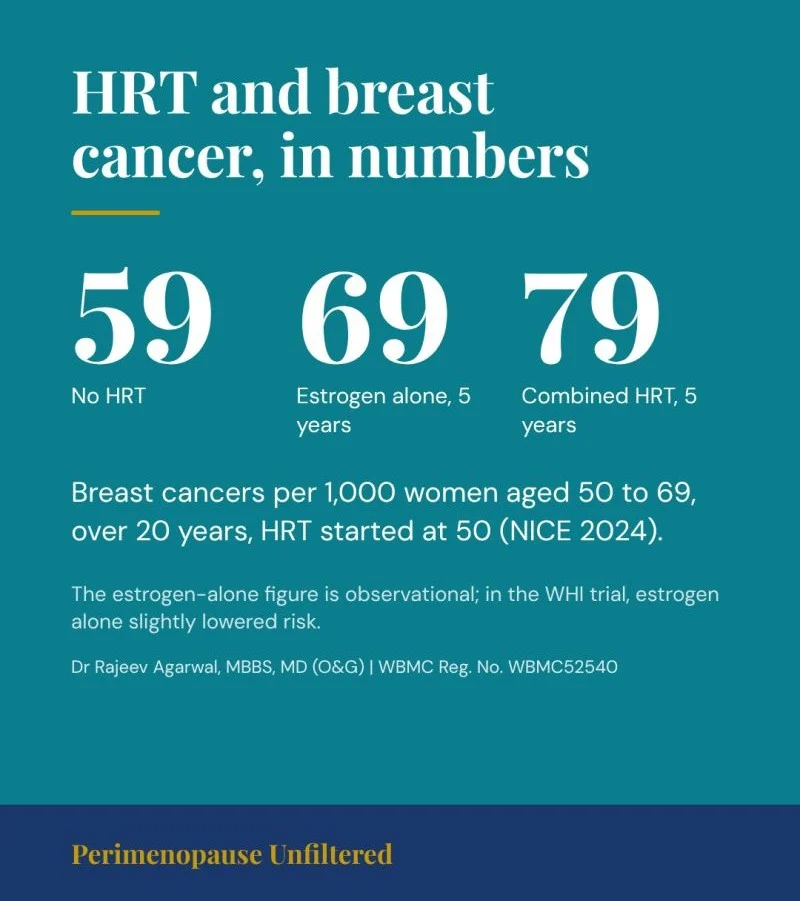
What the studies show. NICE’s 2024 guideline gives figures per 1,000 women aged 50 to 69, over 20 years. Without HRT, about 59 develop breast cancer. With 5 years of combined HRT from 50, about 79, so 20 more. With 5 years of estrogen alone, about 69. The risk rises with duration and falls after stopping, though some excess can persist after longer use.
In the WHI trial, estrogen alone in women without a uterus lowered breast cancer (HR 0.78, about 7 fewer per 10,000 women a year). The observational data and the trial disagree here; either way, the change is smaller than with combined HRT. These figures are for HRT started at 50; for women in their 40s the data are less direct.
The HRT behind the 2002 WHI headline was conjugated equine estrogen with a synthetic progestin. What we discuss today is usually estradiol, often through the skin, with micronised progesterone. A French cohort of 80,377 women, followed for about 8 years on average, found no rise in breast cancer with estrogen plus micronised progesterone (RR 1.00), against a 69% higher relative risk with other progestins. That is observational. Through the skin, estradiol did not raise clot risk in a UK study of 80,396 cases (OR 0.93).
What the guidelines say. The Menopause Society finds the balance favourable for most women under 60, or within 10 years of menopause. In November 2025, the US FDA began removing the boxed warnings from HRT labels. The Indian Menopause Society advises avoiding HRT at moderate or high breast cancer risk.
What I do. In my Perimenopause Unfiltered evaluation, the breast comes before the prescription: a digital mammogram from 40, a breast ultrasound if younger, and for a strong family history, genetic counselling and MRI where indicated. Only then do we weigh her symptoms against her own numbers. Don’t fear hormones. Fear the lack of good information.
What to take away:
- Ask for your risk per 1,000 women, not as a percentage.
- Ask which estrogen, which progestogen, and which route.
- Without a uterus, estrogen alone changes breast cancer risk little, if at all.
- The balance is best under 60 or within 10 years of your last period.
What stopped you, or a woman you know, from asking about HRT: fear of cancer, a doctor’s advice, or family opinion?”
Other articles featuring Rajeev Agarwal on Fertility News.
-
Oct 17, 2026, 16:462 Weeks To Contribute to the FIGO Montréal 2027 Programme
-
Oct 17, 2026, 16:45Pauliina Valpas: 2nd Reflection from the AIFertility Conference
-
Oct 17, 2026, 16:44Barb Collura: “Advocacy 101” Master Class Workshop at the ASRM Congress
-
Oct 17, 2026, 16:41Pregnancy and Infant Loss Awareness Month – Egg Donor and Surrogate Solutions
-
Oct 17, 2026, 16:38Mauro Francesco Pio Maiorano: Why Fertility Preservation Matters Before Gonadotoxic Treatment
-
Oct 17, 2026, 16:36Felicity Jehu-Appiah: Exploring Fertility Treatment Abroad?
-
Oct 17, 2026, 16:33Stanka Matic: Reproductive Health Is Overall Health
-
Oct 17, 2026, 16:30How Do You Scale a Fertility Business While Keeping Its Purpose? – The International Fertility Forum
-
Oct 17, 2026, 16:29Emily S. Jungheim Receives Excellence in Research and Innovation Award – Loyola University Chicago Stritch School of Medicine