

Nicole McPherson: IVF Add-ons Beyond the Headlines
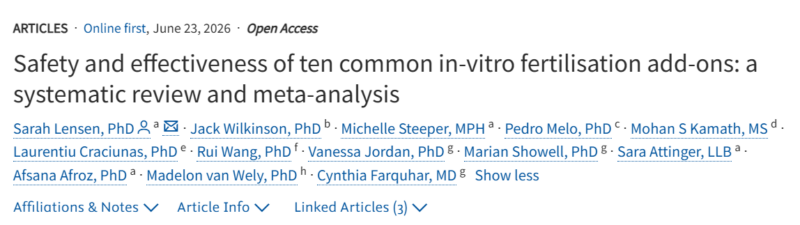
Nicole McPherson, Director of Research, Science Education and Diagnostic Laboratories at Genea, shared a post on LinkedIn about a paper by Sarah Lensen et al. published in The Lancet Obstetrics, Gynaecology and Women’s Health:
“The media is at it again.
‘IVF add-ons don’t work’ is the headline doing the rounds this week, off the back of a new systematic review published in The Lancet Obstetrics, Gynaecology and Women’s Health.
The study itself is good. Lensen et al. reviewed ten common IVF add-ons with rigour, applying a trustworthiness checklist to exclude studies with serious concerns. That kind of methodological care is exactly what the field needs.
But the leap from ‘this is what the study found’ to the headlines being written? That’s where I have a problem.
Absence of evidence is not evidence of absence.
In many cases the evidence was poor, contributing to uncertainty rather than a definitive answer. That’s not the same as saying add-ons don’t work. It means we haven’t done the studies well enough, or in the right patient populations, to know.
Most add-ons aren’t population-wide interventions. They’re used selectively, for patients who haven’t had success through standard treatment. A review that pools underpowered, heterogeneous studies and finds no clear signal doesn’t tell us much about whether a specific add-on helped a specific patient.
Take PGT-A. The headlines say it doesn’t improve live birth rates. But the studies were done predominantly in women under 35, where aneuploidy rates are already low. The authors themselves acknowledge this makes findings uncertain for older women, precisely the group where PGT-A is most commonly used, where aneuploidy is high and miscarriage risk is significant.
And what the data does show, even in this review: PGT-A appears to reduce miscarriage rates. For a couple who has experienced loss, or who is older and working against the clock, fewer miscarriages means fewer cycles, less heartbreak, and a faster path to a healthy pregnancy. The cumulative live birth rate may look similar on paper. What it doesn’t capture is everything that happens in between.
What this paper really highlights is that IVF research is chronically underfunded. The investment required to run large, well-designed RCTs in the right patient populations simply doesn’t exist at the scale we need. That’s the conversation we should be having.
Behind all of this are real people. Every clinician and scientist I’ve worked with has one priority: giving every patient the best possible chance.
Sometimes that means an honest conversation about an add-on, not because the evidence is definitive, but because the standard pathway has been exhausted and doing nothing is also a choice.
We need better evidence. We need better funding. And we need to stop dismissing the clinical judgement of the people doing this work every day.”
Title: Safety and effectiveness of ten common in-vitro fertilisation add-ons: a systematic review and meta-analysis
Authors: Sarah Lensen, Jack Wilkinson, Michelle Steeper, Pedro Melo, Mohan S Kamath, Laurentiu Craciunas, Rui Wang, Vanessa Jordan, Marian Showell, Sara Attinger, Afsana Afroz, Madelon van Wely, Cynthia Farquhar
Stay updated on all scientific advances in the field of fertility with Fertility News.
-
Sep 30, 2026, 17:51Devyanshi Dixit: 11 Years of Knowledge, Connection, Advancing Women’s Health, Now Preparing for the 12th Edition
-
Sep 30, 2026, 17:48Ashley Evans: Infertility Isn’t Something You Can Simply Relax Your Way Out Of
-
Sep 30, 2026, 17:41Mark Trolice: New SIG: Independent Fertility Practices
-
Sep 30, 2026, 17:34Abdelrahman H. Daifalla: The Clinical Reality of IVF Is More Complex…
-
Sep 30, 2026, 17:24Nicole Homan: Ovulation Is Not the Endpoint in PMOS Fertility Care
-
Sep 30, 2026, 17:13Devyanshi Dixit: What Happens When Chronic Pelvic Pain Becomes a Brain Problem?
-
Sep 30, 2026, 16:52Tunzala Ibadova: A Successful IVF Case – Individualized Approach to HLA Compatibility and Embryo Transfer
-
Sep 30, 2026, 16:49Robert Borowczyk: An IVF Conversion Rate Can Jump from 40% to 50% without 1 Extra Patient Starting Treatment
-
Sep 30, 2026, 16:46Asma Khalil: Important Reassurance for Women Who Become Pregnant after Taking GLP-1 Medicines