

Dina Ibrahem: Poor ICM vs. Poor TE
Dina Ibrahem, Embryologist at Queens Fertility Center, shared on LinkedIn:
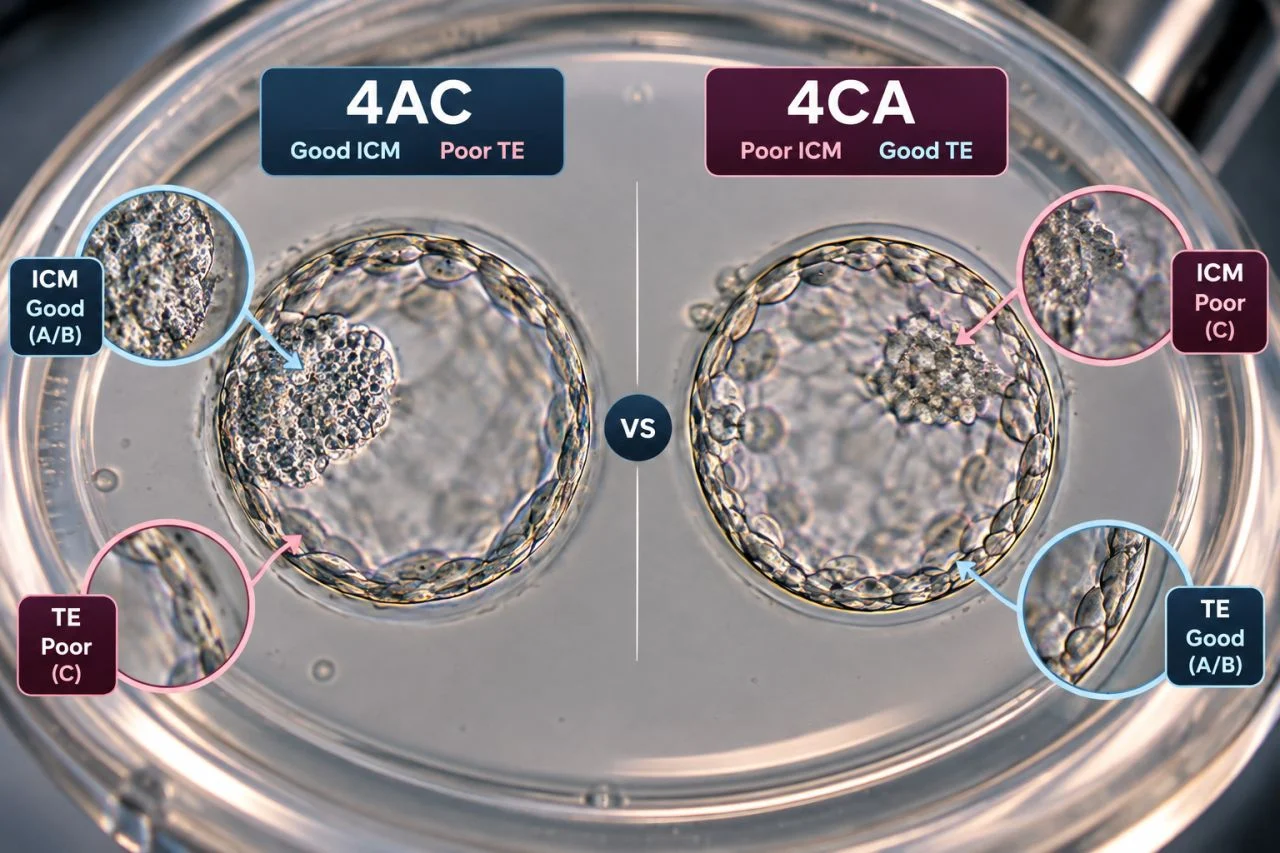
“Poor ICM vs. Poor TE – Are All Grade C Blastocysts Equal?
Two blastocysts. Both Grade C. But do they have the same developmental potential?
Imagine choosing between:
- 4AC: Good ICM, poor TE
- 4CA: Poor ICM, good TE
Would you consider them equally compromised?
A 2026 study published in the Journal of Reproduction and Development explored this question using an extended 3D embryo culture system.
The Study
Researchers investigated 51 human 1PN-derived blastocysts, divided into:
- 20 good-quality blastocysts
- 17 blastocysts with poor ICM
- 14 blastocysts with poor TE
Embryos were cultured until Day 12 to evaluate early developmental organization and cell-lineage differentiation.
The Results
Among embryos assessed for lineage differentiation:
Good-quality: 7/16 (43.8%) formed all three lineages.
Poor ICM: 0/8 (0%) formed all three lineages.
Poor TE: 7/9 (77.8%) formed all three lineages.
The three lineages were:
Epiblast (EPI) | Hypoblast (HYP) | Trophectoderm (TE)
Interestingly, some blastocysts with poor TE retained the ability to establish these lineages, while those with poor ICM showed impaired differentiation.
But Here’s the Important Limitation
These findings do NOT mean poor-TE blastocysts have better implantation or live-birth potential.
The study involved a small number of 1PN-derived embryos, used an experimental culture system, and did not evaluate clinical pregnancy or live birth.
The Takeaway
Poor ICM and poor TE may represent different biological limitations.
But whether this should influence clinical embryo prioritization remains an open question.
Let’s Discuss!
If you had to prioritize a 4AC or a 4CA blastocyst, which would you choose — and why?
Does your laboratory give more weight to ICM or TE morphology when selecting borderline-quality blastocysts?
I’d love to hear different embryologists’ perspectives!
Reference
Cheng C. et al. (2026)
Evaluation of the clinical utility of poor-quality embryos using an extended in vitro embryo culture system.
Journal of Reproduction and Development.”
Other articles featured Dina Ibrahem on Fertility News.
-
Oct 16, 2026, 19:47Sean Lauber: NIPT and Amniocentesis after PGT-A Reveal Few Abnormalities
-
Oct 16, 2026, 19:42Devyanshi Dixit: C-Section vs. Vaginal Birth – 2 Birth Paths, 2 Very Different Recoveries
-
Oct 16, 2026, 19:32Pawel Kordowitzki: Maternal Vitamin D Homeostasis, Pregnancy Outcomes and Offspring Health
-
Oct 16, 2026, 19:13Shizuko Takahashi: Our Study on Women’s Experiences of Assisted Reproductive Care in China Has Been Accepted by RBMO
-
Oct 16, 2026, 19:09ESHRE Announces ECRES-GESEA Reproductive Surgery Training and Certification in Slovenia
-
Oct 16, 2026, 18:20Kabita KB: What Happens if PLCZ1 Is Defective?
-
Oct 16, 2026, 18:12Partha Sarathi Das: From Reproductive Lifespan to Reproductive Healthspan
-
Oct 16, 2026, 18:05Joyce Harper: It Was a Pleasure to Give 2 Talks Celebrating World Menopause Day
-
Oct 16, 2026, 18:01Somil Singhal: The Last Crucial Step in the IVF Journey